Slope Compensation in a golf laser rangefinder calculates the actual yardage to a target by adjusting the flat distance based on the change in elevation between the golfer and the pin. The specific calculation logic required depends entirely on the types of terrain you play most frequently and the precision of the distance data you need for club selection.
Which Slope Compensation Value Suits You?
| If this is you | The Slope Compensation that suits you | Why |
|---|---|---|
| You play primarily on flat, links-style courses or practice ranges. | N/A (Standard Flat Distance) | On level ground, slope compensation is unnecessary as the horizontal distance and actual distance are identical. |
| You play in hilly regions with moderate, rolling elevation changes. | Standard Slope Correction | Most standard algorithms provide a reliable adjustment for moderate inclines that do not require extreme mathematical precision. |
| You play on mountain courses with steep, dramatic vertical drops or climbs. | Advanced or High-Precision Slope | Steep grades require more complex trigonometric calculations to ensure the yardage doesn’t deviate significantly from the true distance. |
| You are a high-handicap golfer who prefers simple, rounded numbers. | Basic Slope Compensation | Simpler logic provides a “good enough” estimate that helps with club selection without overcomplicating the data. |
| You are a low-handicap player seeking professional-grade accuracy. | Professional Grade Optics & Logic | High-end logic minimizes the margin of error when the slope is extreme, ensuring the distance is accurate to within a few yards. |
Reviewed examples from this category
These 3 have their own full review on this site, and run from $109.99 to $269.99.
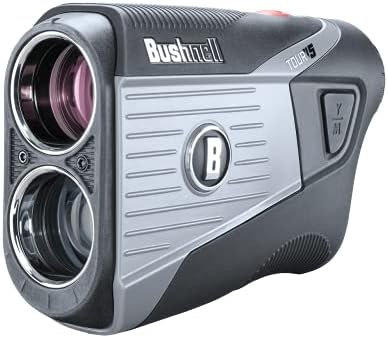
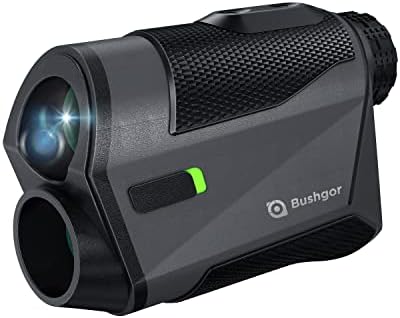
Laser Golf Rangefinder with Slope Measurement
If you are ready to buy, see our comparison of the best golf laser rangefinder with slope mode.
$109.99 price checked August 2026
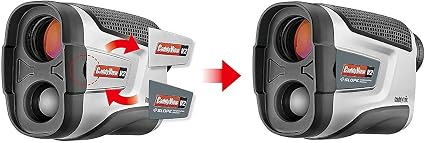
CaddyTek CaddyView V2+ Slope
$139.97 price checked August 2026
Read our full CaddyView V2+ review
New players should look at our guide to the best golf laser rangefinder for beginners.
How to Establish Your Slope Compensation Requirements
To establish your required Slope Compensation, you must identify the maximum and minimum gradients you encounter on your regular courses. This is not a universal number but a requirement based on your specific geography.
Identifying Your Local Terrain Limits
Identify the steepest hole on your most-frequented course. If the elevation change is minor, such as a 10-yard rise over 100 yards, standard logic is sufficient. If the course features “mountain” conditions where the elevation change exceeds 30 yards over a short distance, you require a device that handles high-gradient calculations.
Finding the Logic in the Specifications
Manufacturers usually describe their slope logic in the technical description. Look for terms like “Advanced Slope,” “High-Precision,” or “Pro-Grade.” These indicators tell you how the device handles the math behind the N/A values. If the documentation does not specify a type of slope logic, the device likely uses a basic linear calculation.
Verifying Logic Accuracy
You can verify the logic of a rangefinder by comparing its reading against a known distance on a sloped surface. Find a point where the horizontal distance is known, such as a 100-yard flat shot that has a 10-yard rise. If the rangefinder provides an accurate adjusted distance, the logic is functioning correctly for that specific gradient.
What Goes Wrong with Incorrect Slope Compensation?
Using a Slope Compensation logic that does not match your terrain leads to incorrect club selection, which is the primary failure mode in this category. The mistake manifests as a distance reading that is either too long or too short compared to the actual yardage.
Consider how the weight for golf laser rangefinders affects portability before making your final selection.
Under-Estimating Steep Inclines
If you use a basic slope logic on a very steep mountain course, the device may under-calculate the distance. This happens because the simplified math fails to account for the extreme angle of the slope. You might select a club that is too short, resulting in a ball that fails to reach the green.
Over-Estimating Minor Slopes
Conversely, using high-precision logic on a nearly flat course can occasionally lead to “over-correction.” While the difference is often negligible, some algorithms may interpret minor terrain irregularities as significant slopes, providing a distance that is slightly longer than the actual yardage.
Target Misidentification on Slopes
A major risk when seeking slope data is target misidentification. If the device locks onto a tree or a shrub instead of the flagstick, the slope calculation will be based on the wrong point. Because the slope logic is tied to the coordinates of the target, an incorrect lock results in a completely invalid distance.
What to Do When You Fall Between Two Values?
When your requirements fall between two categories, such as a course that is “hilly” but not “mountainous,” you should prioritize the higher level of calculation. It is better to have a device capable of handling extreme slopes that you rarely see than to have a device that fails when you finally encounter a steep hill.
Choosing the Higher Calculation Tier
If you are unsure whether you need “Advanced” or “Standard” logic, choose the advanced option. High-precision logic remains accurate on flat ground, whereas standard logic is limited by its mathematical ceiling. Choosing the higher tier ensures the device remains useful as your playing locations change or as you encounter more challenging courses.
Returns and Compatibility
Because slope logic is a software and hardware processing decision, it cannot be “resized” once the device is in use. If you purchase a rangefinder and find the slope logic does not match your needs, check the retailer’s return policy. Many electronics retailers allow for returns within 14 to 30 days if the technical specifications do not meet your requirements.
The other Golf Laser Rangefinder guides we have published
- Choosing the Best Golf Laser Rangefinder for Gift Giving
- Best Golf Laser Rangefinders for Beginners
- Golf Laser Rangefinders with Slope Mode Compared
- Choosing the Best Golf Laser Rangefinder for Accuracy
- The Golf Laser Rangefinders That Work Best for Long Distances
- Which Golf Laser Rangefinder with Pin Seeker Is Best?