A 114mm aperture reflector telescope can resolve significant lunar detail and planetary surfaces, but it is limited by its 500mm focal length and atmospheric conditions when attempting to view faint deep-sky objects. While the 114mm aperture gathers three times more starlight than a 70mm refractor, the 500mm focal length provides a relatively wide field of view, which makes it easier to find large targets but limits the extreme magnification needed for tiny planetary details.
The TELMU Reflector Telescope provides a 500mm focal length and a 114mm aperture to produce sharp images of the moon and planets, such as the polar ice caps on Mars. Because this is a reflector telescope—a device that uses curved mirrors to gather and focus light—the secondary mirror creates a slight obstruction that reduces the “usable” aperture compared to a standard Newtonian design. We included the TELMU Reflector Telescope in our comparison because its 114mm aperture serves as a significant step up for those moving from basic entry-level scopes. However, the 150x maximum magnification (achieved with the included 3x Barlow lens) can be hampered by atmospheric “seeing,” where air turbulence blurs the image regardless of the telescope’s hardware specs. For deep-sky targets like faint nebulae, the mount’s tracking accuracy is the primary limitation, as it is designed for steady viewing of bright objects rather than long-exposure tracking.
What to Check Before Buying the TELMU Reflector Telescope
Before purchasing, verify these technical details to ensure the telescope meets your specific viewing goals:
- Check the manual for the specific collimation procedure, as reflector mirrors can shift during transport and require alignment to stay in focus.
- Verify if additional high-quality eyepieces or filters are required for the specific dim objects you intend to observe.
- Confirm the mount’s tracking limits to determine if it can hold steady on targets other than the moon and planets.
- Assess your local atmospheric conditions, as “seeing” limits can prevent you from reaching the hardware’s maximum magnification.
- Calculate the field of view to ensure the 500mm focal length provides enough space for the specific galaxies or clusters you want to see.
Comparing the TELMU Reflector Telescope to Other Options
The TELMU Reflector Telescope sits in a middle ground for hobbyists who need more light-gathering power than a small refractor but aren’t ready for a large Dobsonian. If you require high-magnification planetary observation without extreme chromatic aberration, you might look for a telescope with a longer focal length or a larger aperture. However, for those prioritizing a portable setup that can clearly show lunar craters and cloud bands, this 114mm model provides a balanced compromise between size and optical capability.
If you need more light gathering power, view our comparison of the best 10-inch Dobsonian Reflector Telescope options.
If you primarily want to observe the moon, planets, and bright lunar features, the TELMU Reflector Telescope is a suitable choice. If you require the ability to track faint, distant nebulae over long periods, you should consider a model with a more advanced equatorial mount.
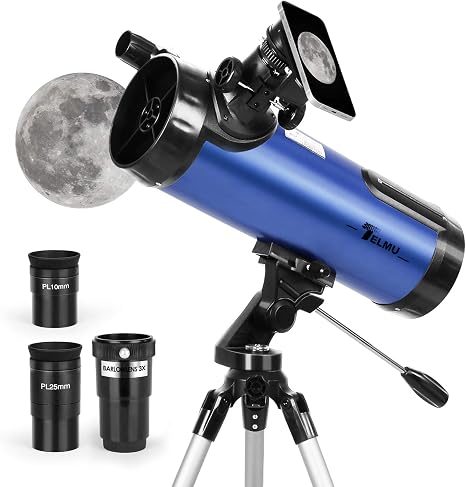
TELMU 114mm Aperture 500mm AZ Mount Reflector Telescope
For those who want to capture images, see our guide to the best reflector telescope with phone adapter for mobile compatibility.
$159.99 price checked August 2026
Browse our other Reflector Telescope pages
- The Reflector Telescopes That Work Best for Beginners
- Which Newtonian Reflector Telescope is Best for Adults?
- Best Reflector Telescopes for Family Stargazing
- 10-inch Dobsonian Reflector Telescopes Compared
- Choosing the Best Reflector Telescope with Phone Adapter
- The Reflector Telescopes That Work Best for Portable Use