The Slokey Discover The World Telescope has significant viewing limitations for deep-sky astronomy because its small aperture is designed primarily for observing the moon and bright planets. While the device provides a clear view of nearby celestial bodies, it lacks the light-gathering power required to resolve faint nebulae or distant galaxies.
The Slokey Discover Telescope features a 3.1″ aperture and a 19″ focal length. In astronomy, aperture determines how much light a telescope can collect; a 70mm aperture is the standard minimum to resolve lunar craters clearly, while 100mm is the threshold where a refractor can reliably show the Andromeda Galaxy. Because this model sits below those thresholds, it will struggle to show anything other than the brightest objects in the night sky. We selected this model for our comparison because it represents the entry-level tier of portable telescopes. The 3.1″ lens provides magnification options up to 250x using the included 6mm eyepiece and 3x Barlow lens, but exceeding the optical limits of the glass can result in a “soft” or blurry image. Furthermore, while the stainless steel tripod features pre-assembled legs for stability, the narrow field of view makes it difficult to center faint objects without a computerized tracking system.
What to Check Before Buying the Slokey Discover Telescope
Because telescope stability and optical limits dictate what you can actually see through the glass, verify these technical details before purchasing:
- Check the maximum practical magnification for a 3.1″ aperture to ensure the image does not become pixelated or blurry.
- Verify the manual focus knob’s travel distance to ensure you can achieve a sharp image on objects at varying distances.
- Confirm the tripod’s threading compatibility to see if you need a specific adapter to keep the unit upright.
- Assess the field of view to determine if you can find targets without a computerized tracking system.
Viewing Limitations of the Slokey Discover Telescope
The Slokey Discover Telescope is a portable tube on a stand that allows you to see the stars and planets. If you require high-resolution planetary imaging or deep-sky detail, you should look at larger refractors or Newtonian reflectors with larger apertures. Buyers who prioritize capturing faint nebulae or large star clusters will find the limitations of a small 3.1″ lens frustrating, as these objects require significantly more light-gathering area than this model provides. This device is intended for basic lunar and planetary observation rather than serious deep-space exploration.
If you are concerned about setup, see if Slokey is easy to mount for those starting out.
If you are a beginner who wants to see the craters of the moon and the rings of Saturn clearly, the Slokey Discover Telescope is a suitable choice. However, if your goal is to photograph distant galaxies or observe faint deep-sky objects, you should choose a telescope with a larger aperture and a more stable equatorial mount.
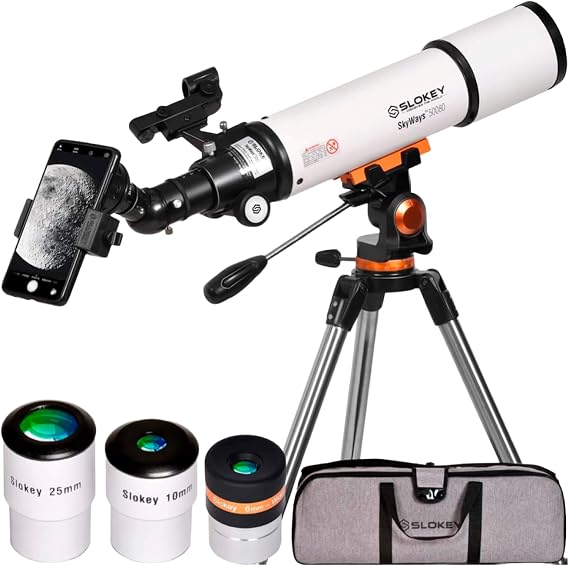
Slokey Discover The World Telescope
You can also explore our comparison of the best astronomy telescope for adults to see other options.
$146.99 price checked August 2026