Most golfers require a golf laser rangefinder with a maximum range of at least 1,000 Yards. This distance ensures the device can accurately measure any shot on a standard course, including long par 5s and extreme hazards.
Recommended Maximum Range for Golf Laser Rangefinders by Use Case
| Use Case | Recommended Maximum Range | Why this number |
|---|---|---|
| Standard Amateur Play | 1,000 Yards | Covers the longest possible shots on standard courses and reaches all hazards. |
| Tournament or Professional Play | 1,200+ Yards | Provides a buffer for extreme long-range shots and ensures high-speed processing at distance. |
| Hunting or Scouting | 1,500+ Yards | Required for identifying targets or terrain features across large, open geographic areas. |
| Practice and Short-Game Focus | 500 Yards | Sufficient for most practice ranges and short-game shots where precision is closer to the player. |
Golf Laser Rangefinders covered by our own reviews
Prices across these 3 run from $139.97 to $149.99; each one has a full review here.
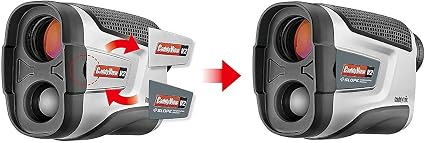
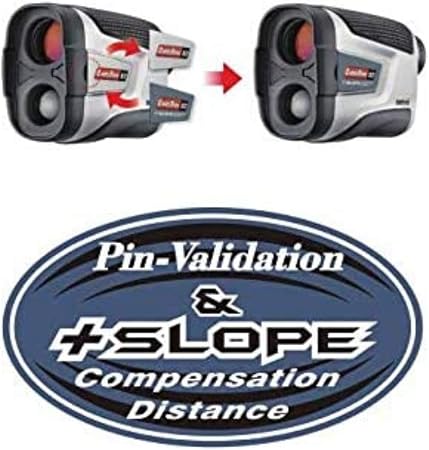
Caddytek Golf Laser Rangefinder LRF-V2-JOLTSLOPE
$149.35 price checked August 2026
Read our full Caddytek LRF-V2 review
New players can find a great starting point by looking at top picks for beginner golf rangefinders.

What Happens if You Under-Provide or Over-Buy Maximum Range?
Under-providing on maximum range occurs when a golf laser rangefinder has a limit lower than 1,000 Yards. If you find yourself on a long par 5 where the green is situated at the edge of the device’s capability, the laser may fail to return a reading entirely.
The Risk of Range Failure
When a device reaches its maximum range limit, it often enters a state of measurement latency or fails to lock onto the target. This happens because the laser’s return signal becomes too weak to be processed by the internal sensor. If you are standing on a tee box and the device cannot calculate the distance to a far-off hazard, the tool becomes useless for that specific shot.
The Real Cost of Over-Buying Range
Over-buying maximum range involves paying for a 1,500 Yard capability when your local courses never exceed 400 Yards of distance from a tee. While a higher number sounds better, it does not inherently improve the accuracy of a 100 Yard shot.
If you need to hit from the tee, see which rangefinders excel at long distances.
The cost of over-buying is primarily financial. Manufacturers often use high range numbers as a marketing tool to justify a higher price point. If you do not need to measure targets beyond 1,000 Yards, the extra capability provides no functional benefit to your game. You are paying for a technical ceiling that you will never reach during a standard round of golf.
The Mistake Most Buyers Make with Maximum Range
The most common mistake buyers make is prioritizing a high maximum range number over the quality of the optical glass and the speed of the processor. A device that can measure 1,200 Yards but takes 5 seconds to calculate a distance is less useful than a 1,000 Yard device that provides an instant reading.
Prioritizing Processing Speed
You should optimize for measurement speed rather than just the maximum distance. A fast processor allows the golf laser rangefinder to distinguish between a flagstick and a nearby tree in milliseconds. If the device is slow, you may miss the correct reading while the unit is still calculating, which is a common failure mode in lower-end hardware.
Prioritizing Optical Clarity
Optical clarity is the other critical factor that matters more than a high range number. High-quality glass ensures that the image remains sharp even when you are looking at a target 300 Yards away. A high maximum range is irrelevant if the image is blurry, as you will be unable to identify the flagstick accurately enough for the laser to lock on.
How Maximum Range Interacts with Other Deciding Specs
Maximum range is a secondary specification because it is often limited by other hardware constraints, such as the sensor’s ability to handle atmospheric interference or the optical zoom level. A high range figure is wasted if the optics cannot provide enough magnification to see the target.
The Magnification Constraint
Magnification is the primary factor that enables a long range measurement. To identify a flagstick at a distance, you generally need at least 6X magnification. If a golf laser rangefinder claims a high maximum range but only offers 3X magnification, you will struggle to see the target clearly enough to get a reading at the edge of that range.
The Target Identification Limit
Target misidentification is a failure mode where the device locks onto a shrub or a tree instead of the flag. This often happens at longer distances where the flagstick occupies a smaller portion of the field of view. To combat this, you need a device with advanced pinseeker technology rather than just a high maximum range number. Pinseeker technology uses software logic to filter out non-target objects, ensuring the distance provided is for the flagstick specifically.
Atmospheric and Environmental Limits
Environmental conditions also dictate the practical range of the device. Factors like heavy fog, rain, or extreme heat can reduce the effective range of any golf laser rangefinder. Because these conditions scatter the laser beam, the maximum range stated by the manufacturer may not be achievable in poor weather. You should choose a device with a robust build and reliable sensor rather than chasing the highest possible yardage number on a spec sheet.
Browse our other Golf Laser Rangefinder pages
- The Golf Laser Rangefinders That Work Best for Long Distances
- Which Golf Laser Rangefinder with Pin Seeker Is Best?
- Best Golf Laser Rangefinders for Fast Measurement
- Golf Laser Rangefinders for Tournament Play Under $450 Compared
- Choosing the Best Golf Laser Rangefinder for Gift Giving
- Best Golf Laser Rangefinders for Beginners