Mount type for reflector telescopes refers to the mechanical system that supports and moves the telescope tube to track celestial objects. The specific mount you need depends on your intended observation targets, your physical ability to move the equipment, and your location’s available space.
Which Mount Type Suits My Needs?
| If this is you | The Mount Type that suits you | Why |
|---|---|---|
| You want to observe planets and the moon from a fixed backyard spot. | Alt-Azimuth Mount | This mount moves in two axes (up-down and left-right), mimicking human movement and offering simplicity for stationary viewing. |
| You plan to track deep-sky objects like nebulae or galaxies for long periods. | Equatorial Mount | An equatorial mount aligns with the Earth’s axis, allowing the telescope to follow objects by rotating on a single axis. |
| You have limited storage space and need to transport the telescope frequently. | Portable Equatorial or Alt-Azimuth | Compact designs prioritize weight reduction and foldability without sacrificing the ability to hold the specific telescope weight. |
| You are a beginner who wants to avoid complex polar alignment procedures. | Alt-Azimuth Mount | Alt-Azimuth systems do not require the precise alignment to the celestial pole that equatorial mounts demand. |
| You intend to perform long-exposure astrophotography of faint targets. | Equatorial Mount | Only an equatorial mount provides the steady, continuous tracking required to keep a faint object centered on a camera sensor. |
Products in this category with a full review here
3 reviewed options, $129.99 to $189.99, with the full write-up behind each name.


Carson Red Planet RP-100 Newtonian Reflector Telescope
If you want to streamline your setup, you can view our roundup of the best Wi-Fi reflecting telescope options available now.
$189.99 price checked August 2026
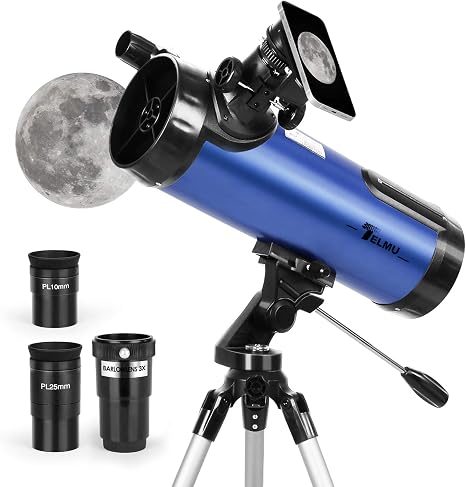
TELMU 114mm Aperture 500mm AZ Mount Reflector Telescope
$159.99 price checked August 2026
Read our full TELMU Reflector Telescope review
New hobbyists should consider our top picks for the best reflector telescope for beginners to start their journey.
How Do I Determine the Correct Mount for My Reflector Telescope?
Determining the correct mount for a reflector telescope requires calculating the weight and balance of the optical tube assembly (OTA). You must identify the weight of the telescope and the counterweight requirements before selecting a mount’s payload capacity.
Calculating Payload and Balance
The weight of the reflector telescope is usually listed in kilograms or pounds in the manufacturer’s specifications. You must ensure the mount’s rated payload capacity exceeds the total weight of the telescope, the finderscope, and the camera or eyepiece accessories.
For equatorial mounts, balance is a critical measurement. You must determine the center of gravity for the telescope tube. This involves finding the point where the tube stays level when held by the mounting rings. The mount must be able to offset this weight using counterweights to prevent motor strain.
Establishing Tracking Requirements
If you intend to do astrophotography, you must establish a tracking accuracy requirement. This is not a weight measurement but a mechanical standard. You need a mount that can provide sub-arcsecond tracking over several minutes. This is typically found in the “tracking accuracy” or “periodic error” specifications of the mount’s motor system.
What Happens if I Choose the Wrong Mount Type?
Choosing a mount type that does not match your specific use case results in either mechanical failure or unusable images. The consequences differ depending on whether the mount is under-powered or incorrectly configured for the telescope’s weight.
Risks of an Under-powered Mount
If you choose a mount with a payload capacity too close to the weight of the reflector telescope, the mount will experience “flexure.” This is a physical bending of the tripod or mount head under the weight of the telescope. In use, this shows up as a blurry image because the telescope is not perfectly steady, even when the mount is locked.
For motorized mounts, an under-powered motor will struggle to move the weight of the telescope against the force of gravity. This results in “backlash” or “stuttering,” where the telescope moves in jerky increments rather than a smooth glide. You will see the object drift out of the field of view rapidly during long observations.
Understanding dimensions is key, so learn how to choose the right tube length for your specific needs.
Risks of an Over-sized Mount
Selecting a mount that is significantly larger than necessary for your reflector telescope creates logistical difficulties. A large equatorial mount requires a much larger footprint and often requires a heavy concrete pier or a very large, heavy tripod to remain stable. If you do not have the space or the ability to transport a large mount, it becomes a burden that prevents you from taking the telescope out.
Furthermore, an oversized mount can make fine-tuning more difficult. If the mount is designed for a much larger telescope, the movement increments may be too coarse for a smaller reflector, making it harder to center small planetary details.
What Should I Do if I Fall Between Two Mount Types?
If you find yourself between an Alt-Azimuth and an Equatorial mount, you should decide based on your primary goal for the telescope. The decision point is whether your priority is ease of use or the ability to capture long-exposure images.
Prioritizing Visual Observation
If your primary goal is visual observation—looking through the eyepiece at planets and the moon—the Alt-Azimuth mount is the correct choice. It is simpler to set up, easier to learn, and provides a stable platform for visual use. You do not need the complexity of an equatorial mount if you do not plan to take long-exposure photographs.
Prioritizing Astrophotography
If your goal is to take photos of deep-sky objects, you must choose the Equatorial mount. There is no middle ground for serious astrophotography; an Alt-Azimuth mount cannot track the movement of the stars across the sky in the way required for long exposures. Even if the Alt-Azimuth mount is easier to use, it will fail to produce clear images of nebulae or galaxies.
Handling Weight Borderlines
If you are between two sizes of the same mount type, always choose the higher capacity. A mount that is slightly over-specced for your reflector telescope will provide a smoother, more stable experience than a mount that is at its absolute weight limit. The extra capacity ensures the gears and motors operate within their intended tolerances, preserving the longevity of the equipment.