Tube length refers to the physical measurement of the main body of a reflector telescope, expressed in mm. Your choice of tube length is decided by your storage space, transport requirements, and your preference for a portable or stationary setup.
Which Tube Length Suits Your Situation?
| If this is you | The Tube Length that suits you | Why |
|---|---|---|
| You need to transport your telescope to public parks or dark sky sites frequently. | Shorter tube lengths (under 800mm) | Shorter tubes are easier to fit into vehicles and require less effort to move between locations. |
| You have a dedicated garden shed or garage for permanent storage. | Medium tube lengths (800mm to 1200mm) | These provide a balance of aperture and length that fits most standard storage spaces while offering high performance. |
| You want a large aperture telescope and do not plan to move it once set up. | Longer tube lengths (over 1200mm) | Larger mirrors require longer tubes to provide the necessary distance for the light to reach the eyepiece. |
| You live in an apartment with limited hallway clearance or small storage areas. | Compact tube lengths (under 600mm) | Compact designs prioritize ease of movement through doorways and compact footprints in tight spaces. |
| You are a hobbyist who prioritizes high-magnification planetary observation over portability. | Longer tube lengths (1200mm+) | Longer tubes are often associated with the longer focal lengths required to achieve high magnification on planets. |
Where these choices show up in our reviews
3 reviewed options, $159.99 to $241.64, with the full write-up behind each name.

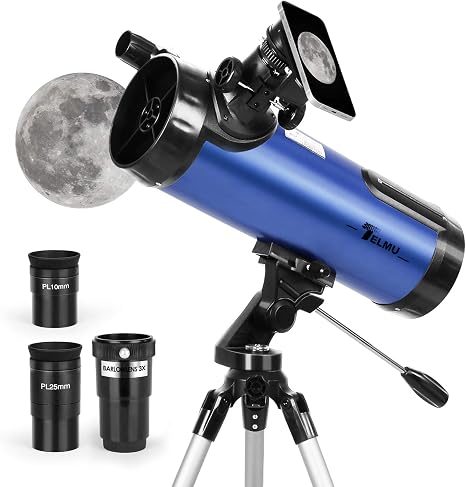
TELMU 114mm Aperture 500mm AZ Mount Reflector Telescope
If you are looking for a shared experience, see the best reflector telescope for family stargazing.
$159.99 price checked August 2026

ESSLNB Astronomical Reflector Telescope 114AZ
$241.64 price checked August 2026
Read our full ESSLNB 114AZ Telescope review
For those needing more aperture, explore the best 10-inch Dobsonian Reflector Telescope options.
How Do You Measure or Establish Your Required Tube Length?
To establish your required tube length, you must measure the physical clearance of your intended storage and transport area. You should measure the length of the telescope tube from the front of the primary mirror housing to the rear of the focuser or finderscope mount.
Measuring Storage Space
Measure the longest straight line available in your storage area, such as a shed, garage, or closet. Ensure you account for the extra space needed to maneuver the telescope into position, as a tube that fits perfectly into a corner might be impossible to rotate or move out of that corner.
Measuring Vehicle Space
If you plan to transport the reflector telescope, measure the interior length of your vehicle’s trunk or cargo area. A reflector telescope is a rigid structure; it cannot be folded. You must ensure the tube length, plus the length of the tripod legs when extended, fits within your vehicle’s dimensions.
Finding the Length on a Specification Sheet
The tube length is usually listed in the technical specifications as “Tube Length” or “Optical Tube Length” (OTL) in mm. Check the manufacturer’s data for the specific number to ensure it matches your measured clearances before ordering.
What Happens if the Tube Length is Too Long or Too Short?
Choosing a tube length that is too long or too short results in practical difficulties rather than a loss of image quality. The length of the tube is a physical constraint, not a performance metric.
Selecting the right support system is vital, so learn about choosing the right mount type for reflector telescopes.
Risks of a Tube Length That Is Too Long
If the tube length exceeds your storage or transport capacity, the telescope becomes difficult to use. You may find that the telescope cannot fit into your car, preventing you from taking it to viewing sites. In a storage environment, a tube that is too long may prevent you from opening doors or accessing other items in your shed.
Risks of a Tube Length That Is Too Short
While a shorter tube is easier to handle, it is often a result of a design meant for portability. If you choose a very short tube to save space, you may find that the telescope is designed for lower-magnification use. A very short tube often indicates a wide-field design, which is excellent for large nebulae but may lack the focal length needed for high-detail planetary views.
What Should You Do if You Fall Between Two Tube Lengths?
If your measurements show that you are on the borderline between two different tube lengths, you should prioritize your most frequent use case. If you plan to move the telescope 90% of the time, choose the shorter length. If the telescope will stay in one place most of the time, choose the longer length.
Prioritising Portability
When caught between two sizes, selecting the shorter tube length is the safer choice for a beginner. It is easier to manage a smaller telescope and move it into position than it is to struggle with a larger, heavier tube that barely fits into your vehicle or storage area.
Prioritising Performance
If the telescope will be stationary, choose the longer tube length. A longer tube often accommodates larger primary mirrors or longer focal lengths, providing more versatility for different types of astronomical targets over the long term.
Checking Return Policies
Because tube length is a physical dimension, ensure you check the return policy of the seller before ordering. If a telescope arrives and is physically too long to fit into your vehicle or storage space, you need to know if the seller accepts returns for sizing issues.
The other Reflector Telescope guides we have published
- Choosing the Best Reflector Telescope with Phone Adapter
- The Reflector Telescopes That Work Best for Portable Use
- Which Reflector Telescope with Motor Drive is Best?
- Best Wi-Fi Reflecting Telescopes
- The Reflector Telescopes That Work Best for Beginners
- Which Newtonian Reflector Telescope is Best for Adults?