A tactical scope is a precision optical device designed to provide a clear, magnified view of a target while allowing a shooter to quickly acquire and engage that target. Unlike a standard hunting scope, which often prioritizes a wide field of view for large game, a tactical scope is engineered for rapid target identification and consistent accuracy under various lighting and environmental conditions.
The problem these optics solve is the trade-off between speed and precision. In high-pressure situations, a shooter needs to see enough detail to distinguish a target from its surroundings, but they also need to be able to move their eye and the reticle quickly. A tactical scope balances these needs by providing high-quality glass and robust internal tracking, ensuring that the point of aim remains consistent even when the shooter is moving or the environment is changing.
How does a tactical scope work?
A tactical scope works by using a series of lenses to gather light, magnify the image, and project it into the user’s eye while maintaining a stable reticle overlay. The process follows these steps:
- Light enters the front objective lens, which gathers the image from the target.
- Internal glass elements refract and converge this light to increase the magnification level.
- The reticle, which is either etched into the glass or projected via an illumination system, stays centered in the field of view.
- The eyepiece lens magnifies the final image and allows the user to view the reticle and the target simultaneously.
- Internal mechanical components, such as the erector tube and turret systems, allow the user to adjust the height and windage of the point of impact.
Tactical Scopes we have reviewed in detail
Prices across these 3 run from $179.95 to $1498.51; each one has a full review here.
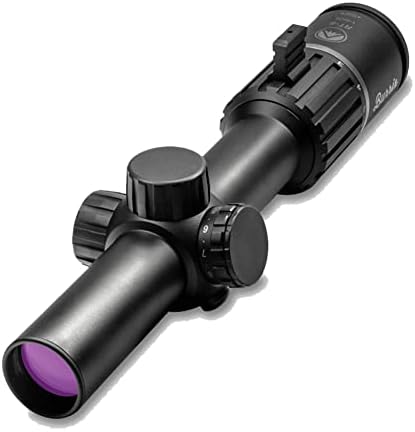
Burris Optics LPVO RT-6 1-6x24mm
$199.99 price checked August 2026
Read our full Burris RT-6 review
If you need a specific magnification range, browse our guide to finding the best 1-8x24mm F1 riflescope.

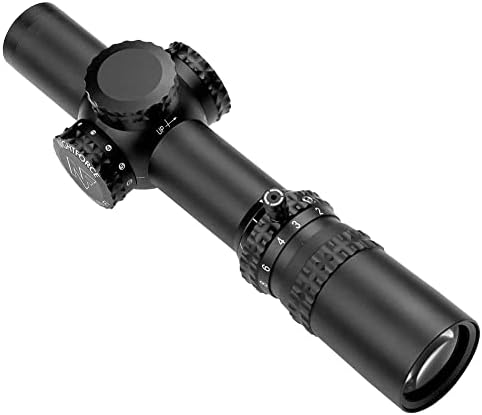
Nightforce ATACR 1-8x24mm F1 Riflescope
For those seeking a versatile low-power option, view our comparison of the best 1-6x24mm tactical riflescope.
$1498.51 price checked August 2026
Parts of a tactical scope that matter to a buyer
Several technical components determine how a tactical scope performs when used in the field. Understanding these terms helps in identifying which features provide actual utility versus unnecessary cost.
Magnification and Field of View
Magnification determines how much larger the target appears compared to the naked eye. For tactical use, many shooters look for a range that allows for both mid-range identification and long-range precision. A lower magnification provides a wider field of view, which helps in finding a target quickly, while higher magnification allows for more precise adjustments on distant objects.
First Focal Plane (FFP) vs Second Focal Plane (SFP)
The focal plane refers to where the reticle sits in relation to the magnification. In a First Focal Plane (FFP) system, the reticle remains accurate at every zoom level, meaning the holdover points on the reticle scale with the magnification. In a Second Focal Plane (SFP) system, the reticle remains the same size regardless of the zoom level, which can make calculating distances more difficult at lower magnifications.
You can also learn common tactical scope terms and specs to better understand the technical data.
Turret Systems and MOA/MRAD
Turrets are the knobs used to adjust the point of impact. These are typically measured in MOA (Minutes of Angle) or MRAD (Milliradians). MOA is a standard where 1 MOA is roughly 1.047 inches at 100 yards. MRAD is a metric system where 1 unit is approximately 10.7 centimeters at 100 meters. Choosing between these depends on the personal preference of the shooter and the specific units used for range estimation.
Eye Relief and Parallax
Eye relief is the distance from the eye to the scope’s lens where the user sees a full, clear image. Proper eye relief prevents “scope shadow,” where the shooter’s own head blocks the view. Parallax is the perceived shift of the reticle relative to the target when the eye is not perfectly centered. High-quality tactical scopes include a parallax adjustment to ensure the reticle stays on the target regardless of the shooter’s position.
What a tactical scope changes in practice
Having a tactical scope changes how a shooter interacts with a target by providing consistent data and clarity in specific scenarios. In a situation where a target is at a distance of 300 to 600 meters, a tactical scope allows the user to see enough detail to identify the target’s position accurately, which a standard iron sight or low-power optic might struggle to do.
The difference shows up most clearly during rapid target acquisition. Because of the high-quality glass and tracking, a tactical scope helps the user maintain a steady point of aim while the rifle is being moved. However, the difference does not show up in close-quarters engagements where the target is only a few feet away. In those instances, the high magnification and complex reticle of a tactical scope can actually limit the field of view, making a simpler red dot or low-power optic more practical.
Who needs a tactical scope?
A tactical scope is necessary for shooters who require consistent accuracy at mid-to-long ranges and who need to identify targets quickly in varied environments. This typically includes precision marksmen, long-range enthusiasts, and those who need to engage targets at distances where the human eye cannot reliably estimate the point of impact.
A tactical scope is not needed for those who primarily engage targets at very close ranges, such as in home defense or close-quarters competition. In those scenarios, the weight and magnification of a tactical scope provide no benefit and may hinder the ability to see the surrounding environment. Additionally, for those who do not require precision at distance, a simpler, less expensive optic provides a more efficient solution for the budget.