When shopping for tactical scopes, buyers often find themselves overwhelmed by a mix of critical engineering specifications and marketing fluff. Load-bearing terms—the ones that dictate how the optic performs under pressure—include tube diameter, focal plane, and magnification limits. These are the metrics that determine if a scope will stay on your rifle or provide a clear image at 300 yards. Conversely, many adjectives like “elite,” “advanced,” or “tactical-grade” are marketing vocabulary used to justify a higher price point without offering a measurable performance increase. You should ignore the adjectives and focus on the numerical standards and material types listed below.
Tactical Scope Performance and Capability Terms
The following terms define what the optic can do and how it handles target acquisition at various distances.
- Magnification – This is the power of the lens, such as 1-6x or 4-12x, which determines how much the image is enlarged. A higher second number allows for longer-range identification, while a lower first number is better for close-quarters use.
- 1x True Magnification – This means the optic provides a 1:1 image of the target without any zoom. This is a critical threshold for those who need the scope to function as a red dot sight for close-range engagements.
- Field of View (FOV) – This measures the width of the area visible through the lens. A wider FOV is better for situational awareness and finding targets quickly in dense environments.
- First Focal Plane (FFP) – In an FFP scope, the reticle remains in the same position relative to the target regardless of the zoom level. This is better for precise holdovers at varying distances.
- Second Focal Plane (SFP) – In an SFP scope, the reticle expands or shrinks as you zoom. While less useful for long-range holdovers, SFP optics are often lighter and less expensive.
- MOA (Minutes of Angle) – This is a measurement of angular distance used for turret adjustments. One MOA is approximately 1.047 inches at 100 yards.
- MRAD (Milliradians) – This is a metric unit of angular measurement where 1 MRAD equals 10.74 inches at 100 yards. MRAD is often preferred by those who want a 1:1 ratio between the reticle’s subtended distance and the turret’s movement.
- Parallax Adjustment – This is the ability to align the reticle with the target at different distances. A dedicated parallax knob is essential for accuracy at long ranges to prevent the reticle from appearing to “float” off the target.
Where these choices show up in our reviews
These 3 have their own full review on this site, and run from $419 to $2800.
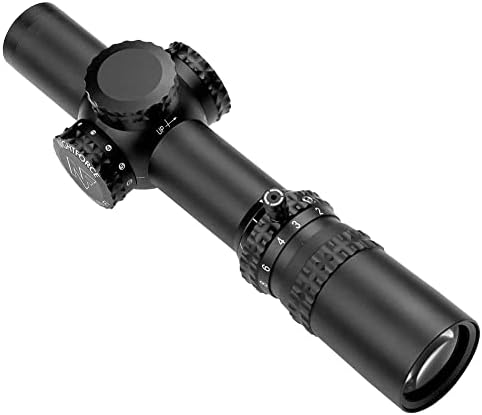


Nightforce NX8 1-8x24mm F1
To understand the core technology behind these optics, learn how a tactical scope works and its primary functions.
$2800 price checked August 2026
Tactical Scope Physical and Build Terms
These terms describe the physical dimensions and construction materials of the optic.
- 30mm Tube Diameter – This is the thickness of the main body of the scope. A 30mm tube is the industry standard for structural rigidity and provides enough internal space for high-quality glass and large reticles.
- Eye Relief – This is the distance from your eye to the rear lens where the reticle is most visible. A wider eye relief range is better for ensuring a clear image and preventing “scope shadow” when using different shooting positions.
- Turret Style – This refers to the knobs used to adjust elevation and windage. “Click” values (the amount of movement per turn) should be clearly stated, as a smaller click value allows for finer precision.
- Nitrogen Purged – This indicates the scope is filled with nitrogen gas to prevent internal fogging caused by temperature changes. This is a standard requirement for reliable performance in varied climates.
- Hardened Coating – This refers to the exterior finish of the objective and ocular lenses. A high-quality coating reduces glare and improves light transmission in low-light conditions.
Tactical Scope Mounting and Compatibility Terms
Compatibility terms ensure the scope will physically and mechanically work with your specific rifle system.
- Picatinny / Weaver Rail – These are the standard grooves and ridges on a rifle mount. Most modern tactical scopes are designed to mount on these standardized rails.
- Compatible Weight Rating – This is the maximum weight a scope can handle before the internal tube may warp or the glass may shift. You must ensure your scope’s rating exceeds the weight of your rifle and accessories.
- Tracking Drift – This is a failure mode where the point of impact shifts during rapid target acquisition due to poor internal construction. High-quality optics are engineered to minimize this drift.
- Reticle Shadow – This occurs when the eye is too close to the scope, causing the user’s eyelashes or brow to block the view. Proper eye relief and a wide relief range eliminate this issue.
Commonly Confused Tactical Scope Terms
Several terms in the tactical optic market are frequently used interchangeably but represent different technical capabilities.
MOA vs. MRAD
While both are units for measuring distance, MOA is an imperial-based unit (roughly 1 inch at 100 yards) and MRAD is a metric-based unit (roughly 10.7 inches at 100 yards). You must choose one system and stick to it, as the turret adjustments for an MOA reticle will not match the scale of an MRAD reticle.
First Focal Plane vs. Second Focal Plane
The difference lies in the reticle’s behavior during zooming. In First Focal Plane (FFP), the reticle stays “locked” to the target at any zoom level, making it superior for long-range holdovers. In Second Focal Plane (SFP), the reticle grows as you zoom, which is sufficient for many applications but less precise for varying distances.
Magnification vs. Zoom
Magnification refers to the specific power of the lens (e.g., 4x), while “zoom” is the general action of changing that power. A “variable” scope allows for a range of magnification, whereas a “fixed” scope stays at one power level. For a tactical application, you need to know if the magnification range covers your intended engagement distance.
Before ordering any optic, confirm the specific mounting requirements and local regulations for your region to ensure the equipment meets your needs and requirements.