Tactical scopes are primarily divided by their intended engagement range and the resulting optical geometry. While marketing often creates sub-categories based on aesthetic features, the fundamental split that dictates a buying decision is whether the optic is designed for rapid, close-quarters target acquisition or for precise, long-range ballistics. This distinction determines the magnification range, the reticle design, and the physical weight of the unit.
What are Red Dot Scopes?
Red dot scopes provide a 1x magnification that allows the optic to function as a red dot sight for close-quarters engagements. These sights use a battery-powered illuminated reticle projected onto a large glass lens, providing a wide field of view and rapid target acquisition.
Who uses red dot scopes?
You should choose a red dot scope if your primary role involves rapid target identification at distances under 50 meters. These are standard for high-mobility roles where speed of engagement is more critical than precise distance holdovers.
What do red dot scopes give up?
Red dot scopes lack the ability to magnify a target, which limits their utility in long-range scenarios. They also generally lack the complex turrets found on high-magnification optics, meaning they are not suitable for precision shooting at extended distances.
These optics sit at the lowest price point relative to other tactical scopes due to their simpler internal construction and lack of complex zoom mechanisms.
Where these choices show up in our reviews
Prices across these 3 run from $179.95 to $1498.51; each one has a full review here.

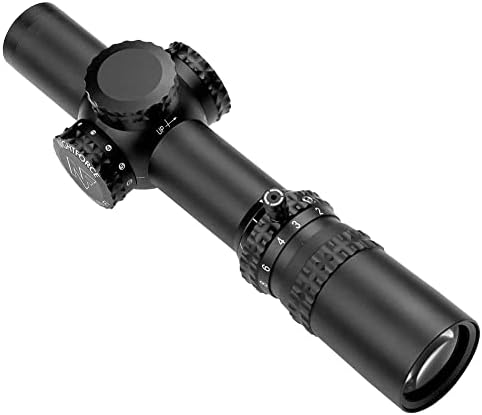
Nightforce ATACR 1-8x24mm F1 Riflescope
If you need a versatile mid-range option, see our top-rated 4-16×50 tactical riflescope picks.
$1498.51 price checked August 2026

What are LPVO Scopes?
Low Power Variable Optics (LPVO) provide a versatile range of magnification, typically between 1x and 10x. These scopes allow the user to switch between a 1x “red dot” style view for close work and a magnified view for mid-range targets.
Who uses LPVO scopes?
You need an LPVO if you require a “do-it-all” optic that can transition between different engagement distances. They are ideal for operators who move between environments where the distance to a target can change rapidly.
What do LPVO scopes give up?
LPVOs often have a smaller objective lens than dedicated long-range scopes, which can limit light transmission in low-light environments. Because they must remain compact, the clarity at the highest magnification may not match a dedicated high-power optic.
For those requiring higher magnification, view our 5-30×56 tactical riflescope comparison guide.
LPVOs sit in the mid-range price bracket, offering a balance between the simplicity of a red dot and the complexity of a precision scope.
What are Precision Tactical Scopes?
Precision tactical scopes are high-magnification optics designed for consistent accuracy at long ranges, often featuring magnifications of 3x to 25x or higher. These units prioritize glass clarity and mechanical precision over wide-field views.
Who uses precision scopes?
You should prioritize a precision scope if your role requires hitting targets at 300 meters or beyond. These optics are designed for stable, deliberate shots where the user has the time to dial in adjustments for distance and windage.
What do precision scopes give up?
Precision scopes are heavy and bulky, making them less suitable for high-mobility maneuvers. They also have a much narrower field of view, which can make it harder to track moving targets at close range.
Precision scopes sit at the highest price point due to the high-quality glass, complex internal tracking systems, and heavy-duty housing required for long-range stability.
Tactical Scope Comparison
| Scope Type | Best-Fit Buyer | Main Advantage | Main Compromise |
|---|---|---|---|
| Red Dot | Close-quarters operators | Rapid target acquisition | No magnification |
| LPVO | Multi-range users | Versatility across distances | Reduced light transmission |
| Precision | Long-range marksmen | High-magnification clarity | Weight and bulk |
How do you know which type you need?
To determine which type of tactical scope fits your requirements, check your operational environment against these three conditions.
Check your maximum engagement distance
If you will rarely engage targets beyond 50 meters, a red dot scope is the most efficient choice. If your range is unpredictable but rarely exceeds 300 meters, an LPVO provides the necessary versatility. If you must engage targets at 500 meters or more, a precision scope is required.
Check your movement requirements
If you need to move quickly and carry your equipment over long distances, the weight of a precision scope may be a liability. A red dot or a lightweight LPVO will provide better balance and maneuverability. If you are stationary or moving slowly, the weight of a precision optic is a secondary concern to its accuracy.
Check your required accuracy
If “hitting the target” is sufficient and speed is the priority, the simplicity of a red dot is ideal. If you need to hit specific small areas at a distance, you need the magnification and reticle holdovers provided by an LPVO or a precision scope.
Browse our other Tactical Scope pages
- Best 4-16×50 Tactical Riflescopes
- 5-30×56 Tactical Riflescopes Compared
- Choosing the Best Tactical Riflescope with Illuminated Reticle
- The Tactical Riflescopes That Work Best for Budget Competition Shooting
- Tactical Riflescopes for Hunting Compared
- Choosing the Best 1-8x24mm F1 Riflescope for Tactical Use