Most tactical scopes require a maximum magnification between 6x and 25x depending on the specific engagement distance. You should select a range that aligns with your primary target distance rather than choosing the highest number available.
Recommended Maximum Magnification for Tactical Scopes by Use Case
| Use Case | Recommended Maximum Magnification | Why this number |
|---|---|---|
| Close Quarters / CQB | 1x to 4x | Provides a wide field of view for rapid target acquisition in confined spaces. |
| General Purpose / Home Defense | 1x to 6x | Balances a usable field of view with enough zoom to identify targets at 50-100 meters. |
| Mid-Range Tactical Engagement | 6x to 12x | Provides sufficient clarity for 100 to 300 meters without excessive image shake. |
| Precision Long Range | 15x to 25x | Allows for precise holdovers and target identification at 300 to 600 meters. |
| Extreme Long Range | 25x+ | Required for identifying specific targets beyond 600 meters, though field of view narrows significantly. |
Products in this category with a full review here
From $148.99 to $355: the 3 in this category we have reviewed in full.

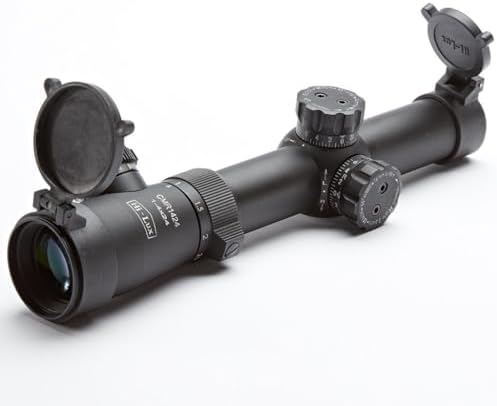
Leatherwood Hi-Lux CMR-AK762 Tactical Scope
$355 price checked August 2026
Read our full CMR-AK762 Scope review
For low-light conditions, you can explore our selection of illuminated reticle riflescopes.

What Happens if You Under-Provision or Over-Buy Magnification?
Risks of Under-Provisioning Magnification
Under-provisioning occurs when the maximum magnification is too low to resolve a target at your intended engagement distance. If you require a 300-meter engagement but use a 4x maximum, the target may appear as a blurry shape rather than a distinct object. This lack of detail makes it difficult to identify specific threats or determine the best point of impact, potentially leading to missed shots or hesitance in high-pressure situations.
The Real Cost of Over-Buying Magnification
Over-buying magnification introduces practical limitations that can hinder performance. High magnification levels, such as 30x or higher, result in a very narrow field of view, making it harder to track moving targets or maintain situational awareness. Furthermore, high magnification amplifies the effects of any movement; even minor tremors or the recoil of the rifle can cause the reticle to jump significantly, making a precise shot harder to execute than with a lower power optic.
The Mistake of Optimizing for Peak Power Instead of Versatility
Many buyers make the mistake of assuming a higher maximum magnification is always better because it allows for longer range. They often select the highest number available in a price bracket, assuming it provides more capability. In reality, the most effective tactical scopes prioritize a usable field of view and a smooth zoom transition.
If you are on a strict budget, see top-rated budget options for competition shooting.
Optimizing for Versatility and FOV
You should optimize for the magnification range you will use 90% of the time. If your primary goal is mid-range work, a 10x or 12x maximum provides a much more stable and usable image than a 25x optic that is difficult to keep steady. Focus on a “sweet spot” where the magnification provides enough detail for your longest expected shot while remaining usable for your shortest expected shot.
How Maximum Magnification Interacts with Other Deciding Specs
Maximum magnification does not exist in a vacuum; its utility is limited by the physical and optical standards of the scope. A high magnification number is only useful if the other components of the optic can support that level of zoom.
The 30mm Tube Diameter Threshold
The 30mm tube diameter is a critical capability threshold for high-magnification optics. A larger tube allows for more internal optic clearance and larger glass elements. If you choose a high maximum magnification on a thin tube, you may experience a significant drop in light transmission and image clarity as you zoom in, as the internal components have less room to move.
Parallax Error and Tracking Drift
As magnification increases, the impact of parallax error becomes more pronounced. If the optic is not properly adjusted or does not have a First Focal Plane (FFP) reticle, the point of impact can shift as the target moves closer or further away. High magnification also highlights tracking drift; if the internal construction is not of high quality, the reticle may “float” or shift during rapid movement, rendering the high magnification useless for precision.
Eye Relief Incompatibility at High Power
Higher magnification levels often require more precise eye relief. If the distance between your eye and the lens is even slightly off, you may experience “scope shadow” or a black ring around the image. When using high-power tactical scopes, you must ensure the optic allows for enough eye relief to accommodate different shooting positions, otherwise, the magnification becomes unusable in practical scenarios.
First Focal Plane vs Second Focal Plane
The choice between First Focal Plane (FFP) and Second Focal Plane (SFP) is vital when choosing high magnification. In an FFP system, the reticle remains accurate at all zoom levels, which is essential for holdovers. In an SFP system, the reticle only holds its correct point of aim at the lowest power setting. If you plan to use the maximum magnification for distance shots, FFP is the standard for ensuring your holdovers remain valid as you zoom.
Local Regulations and Requirements
Rules regarding the use and possession of high-magnification optics vary significantly by country, state, and city. You should confirm the current rules for your specific location before ordering or using any tactical optic.
Every Tactical Scope guide in this category
- Choosing the Best Tactical Riflescope with Illuminated Reticle
- The Tactical Riflescopes That Work Best for Budget Competition Shooting
- Tactical Riflescopes for Hunting Compared
- Choosing the Best 1-8x24mm F1 Riflescope for Tactical Use
- The Tactical Riflescopes That Work Best for 1-6x24mm Use
- Which Tactical Riflescope Is Best for Long Range Shooting?