Tube Weight refers to the actual mass of the telescope’s optical tube assembly measured in kg. Your specific requirements for portability, mounting stability, and physical handling determine which weight is correct for your setup.
Which Telescope Tube Weight Suits You?
| If this is you | The Tube Weight that suits you | Why |
|---|---|---|
| You need to transport the telescope in a standard vehicle and carry it over uneven terrain. | Under 10 kg | Lower mass allows for easier single-person transport and fits in smaller storage spaces. |
| You plan to set up the telescope in a backyard and leave it on a permanent, heavy-duty tripod. | 10 kg to 20 kg | This range balances manageable setup weight with the stability needed for medium-sized apertures. |
| You are mounting the telescope on a heavy-duty pier or a permanent ground-based mount. | Over 20 kg | High mass provides maximum stability for large apertures where portability is not a requirement. |
| You require a setup that can be quickly assembled and disassembled by one person in a public park. | Under 7 kg | Minimal weight ensures the tube can be handled quickly without requiring a second person for balance. |
Reviewed examples from this category
Prices across these 3 run from $229.99 to $599.95; each one has a full review here.

Gskyer 130EQ Professional Astronomical Reflector Telescope
$269.99 price checked August 2026
Read our full Gskyer 130EQ review
If you are planning to travel to dark sky sites, compare the best portable telescope for astronomy to find a compact setup.

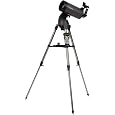
Celestron NexStar 90SLT-Mak
Budget-conscious hobbyists can view the best computerized telescope under $1000 to see automated options at a lower price point.
$599.95 price checked August 2026
How Do I Establish My Own Tube Weight Requirement?
To establish your own tube weight requirement, you must identify your primary transport method and your intended mounting surface. You should determine the maximum weight you can comfortably lift alone and the weight capacity of your intended mount.
Checking Mount Weight Capacity
The maximum weight a mount can support is usually listed in the manufacturer’s technical specifications as “Payload Capacity” or “Maximum Load.” You must ensure the telescope’s tube weight, plus the weight of any accessories like cameras or finderscopes, remains below this stated limit.
Understanding how tube weight impacts stability requires you to learn how focal length for telescopes affects your viewing experience.
Locating the Weight on the Product
The weight of the tube is typically found in the “Specifications” or “Technical Data” section of the manufacturer’s documentation. It is usually listed as “Tube Weight” or “Optical Tube Weight” in kg. If only “Gross Weight” is listed, that figure includes the tripod and accessories, so you must subtract those components to find the specific tube weight.
Assessing Your Transport Capability
If you need to move the telescope, measure the distance from your storage area to your viewing location. If that distance involves stairs or a long walk, a tube weight under 10 kg is generally the limit for comfortable solo transport. For larger tubes, you may need to factor in a trolley or a second person to move the unit safely.
What Happens if the Tube Weight is Wrong?
Choosing a tube weight that is too high for your mount or your physical ability leads to mechanical instability and safety risks. If the tube weight exceeds the mount’s rated capacity, the motors may struggle to move the telescope, or the mount may “drift” as the gears fail to hold the weight against gravity.
Consequences of Excessive Weight
A tube weight that is too heavy for your chosen mount results in “shake” during high-magnification viewing. Even a slight touch or a breeze can cause the telescope to vibrate because the mount lacks the counter-leverage to stabilize the heavy mass. This makes it difficult to keep planets or the moon in the center of the eyepiece.
Consequences of Insufficient Weight
While a lower weight is easier to move, a tube that is too light for a large aperture can sometimes indicate a lack of structural rigidity. If a tube is designed to be very light but lacks sufficient material thickness, it may flex under its own weight when pointed at high angles, leading to blurry images.
Once you have your weight requirements, discover the right mount type for telescopes to ensure a steady image.
What if I Fall Between Two Weight Categories?
If your requirements fall between two weight categories, you should prioritize the stability of your intended mounting location. If you are using a permanent mount, choosing the heavier option provides a more stable platform for high-resolution imaging.
Choosing for Stability
When choosing between two weights for a stationary setup, the heavier tube is often preferable as it provides a more rigid platform. A heavier tube helps dampen vibrations, which is a critical factor when you are trying to resolve fine details in deep-sky objects.
Choosing for Portability
If your primary concern is moving the telescope, you should choose the lighter option. It is better to have a slightly less stable but portable telescope than a heavy telescope that you cannot physically move to your viewing site. If the weight is at the limit of your capability, consider if you can use a transport trolley to bridge the gap.
Checking Return Policies
Because weight is a physical constraint that is difficult to assess until the item arrives, check the return policy before ordering. Ensure the seller allows for returns if the weight exceeds your physical ability to move the unit or if it does not fit in your transport vehicle.