There are four meaningfully different types of telescopes defined by their optical design and the way they gather light. The primary dimension that separates these options is the trade-off between aperture size, portability, and the complexity of the optical path. This choice determines whether you prioritize high-resolution planetary detail, wide-field deep-sky views, or the ability to transport the equipment to a remote location.
What are Refractor Telescopes?
Refractor telescopes use a series of lenses to gather and focus light. This design is the most traditional form of telescope, where the light enters the front of a tube and passes through a large objective lens to reach the eyepiece.
Refractor telescopes are for the observer who prioritizes image sharpness and low maintenance. Because the light path is straight, these models produce very high-contrast images, making them the preferred choice for viewing the Moon and planets. They do not require internal alignment or “collimation” during use.
A refractor telescope gives up on aperture size relative to its physical length. To achieve a large aperture, the tube must become very long and heavy, which limits portability. They sit in a mid-to-high price band depending on the glass quality; high-end “apochromatic” lenses that eliminate color fringing are significantly more expensive than standard designs.
Where these choices show up in our reviews
Prices across these 3 run from $146.99 to $1699.99; each one has a full review here.
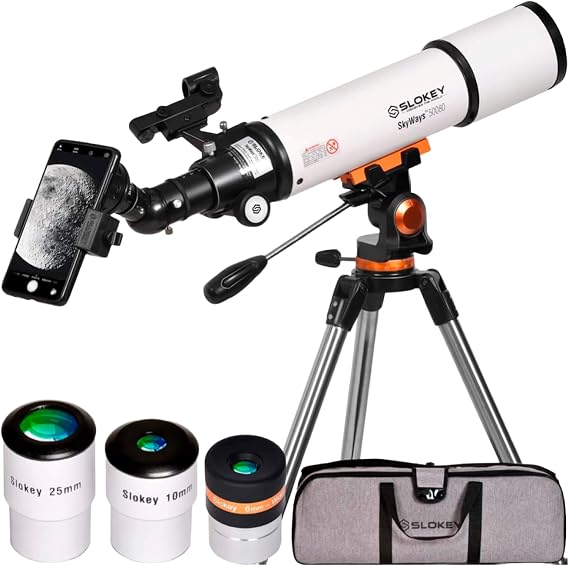
Slokey Discover The World Telescope
$146.99 price checked August 2026
If you need to travel with your gear, see our list of the best portable telescope for astronomy.

Celestron AstroMaster 130EQ Newtonian Telescope
$269.99 price checked August 2026
Read our full AstroMaster 130EQ review
For automated tracking on a budget, explore top-rated computerized telescope under $1000.

What are Reflector Telescopes?
Reflector telescopes, specifically Newtonian reflectors, use curved mirrors instead of lenses to gather light. The light enters the open end of the tube, hits a primary mirror at the bottom, and reflects toward a secondary mirror that directs the image to an eyepiece at the side.
Reflector telescopes are for the observer who wants the most light-gathering power for the lowest cost. Because mirrors can be made much larger and cheaper than precision lenses, reflectors allow you to see fainter, more distant objects like nebulae and galaxies.
Selecting the right base is crucial, so learn how to choose the right mount type for telescopes.
A reflector telescope gives up on ease of maintenance. Mirrors can shift out of alignment over time or during transport, requiring the user to perform “collimation” to ensure the image remains sharp. They typically sit in a lower price band for large apertures compared to refractors.
What are Schmidt-Cassegrain Telescopes?
Schmidt-Cassegrain (SCT) telescopes are “catadioptric” designs, meaning they use a combination of mirrors and lenses to fold the light path into a very short tube. A corrector lens at the front and a primary mirror at the back allow for a large aperture in a compact body.
Schmidt-Cassegrain telescopes are for the observer who needs a large aperture but has limited storage space or needs to transport the telescope in a vehicle. They provide a middle ground between the high-contrast of a refractor and the light-gathering power of a reflector.
A Schmidt-Cassegrain telescope gives up on “fast” focal ratios. Because the light is folded multiple times, the image can be harder to capture in short exposures, and the complex optics can be more expensive to manufacture. They sit in a higher price band than standard reflectors.
Telescope Type Comparison
| Telescope Type | Best-Fit Buyer | Main Advantage | Main Compromise |
|---|---|---|---|
| Refractor | Planetary & Lunar observers | High contrast and low maintenance | Limited aperture for the size |
| Reflector | Deep-sky & faint object hunters | Maximum aperture per dollar | Requires frequent alignment |
| Schmidt-Cassegrain | Space-constrained high-power users | Compactness and large aperture | Higher cost and slower focal ratio |
How do you choose the right telescope type?
You belong in the refractor category if you prioritize a “set it and forget it” experience. If your primary goal is to see crisp details on the surface of the Moon or the rings of Saturn, and you do not mind a shorter focal length, a refractor is the standard choice.
You belong in the reflector category if you want to see the smallest, faintest details of the universe. If you are willing to spend time periodically adjusting the mirrors to ensure the image is sharp, and you want the largest possible mirror for your budget, a Newtonian reflector is the correct path.
You belong in the Schmidt-Cassegrain category if you need a “do-it-all” instrument that fits in a small trunk. If you want to see deep-sky objects but cannot store a large, heavy reflector in your home, and you are willing to pay a premium for a compact design, an SCT meets those requirements.
Reviewed by the RecommendedOptics editorial team. RecommendedOptics writes these guides from the 200 most-reviewed telescope listings in our retail dataset, not from manufacturer copy.