A golf rangefinder with slope is a handheld optical device that measures the distance to a target and automatically calculates the adjusted yardage based on the incline or decline of the terrain. It allows a golfer to see how much farther or shorter a shot will travel compared to a flat surface, providing a specific number to help choose the correct club.
The primary problem this technology solves is the inaccuracy of measuring distance on uneven ground. On a standard flat course, a 150-yard shot requires a specific club. However, if that 150 yards is played on a steep uphill slope, the ball will not travel as far as it would on flat ground. Without a slope-adjusted calculation, a golfer might choose a club that is too weak, resulting in a short shot. Conversely, a downhill slope requires a stronger club than the flat distance suggests. A slope rangefinder removes the guesswork of estimating these changes by providing a corrected distance value instantly.
How does a golf rangefinder with slope work?
A golf rangefinder with slope works by using a laser and a specialized processor to calculate the change in elevation between the golfer and the target.
- The user points the device at the flagstick or target and presses the button.
- The device emits an infrared laser beam that bounces off the target and returns to the sensor.
- The internal processor measures the time it took for the light to travel to the target and back to determine the linear distance.
- The device simultaneously measures the angle of the slope between the user’s position and the target.
- The software applies a mathematical algorithm to the linear distance and the measured angle.
- The display shows the “true” distance (the flat distance) and the “slope” distance (the adjusted yardage).
Golf Rangefinders With Slope we have reviewed in detail
Prices across these 3 run from $199 to $299; each one has a full review here.

Precision Pro NX Slope Golf Rangefinder
$199 price checked August 2026
Read our full Precision Pro NX review
New players can start their journey by looking at top-rated slope rangefinders for beginners.

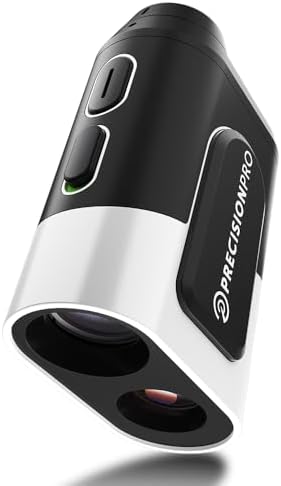
Precision Pro NX9 Golf Rangefinder
$199 price checked August 2026
Read our full Precision Pro NX9 review
Understanding the technical side is easier when you view common slope rangefinder specs explained.
Key components of a golf rangefinder with slope
Several technical components determine the accuracy and usability of a golf rangefinder with slope for the end user.
Optical Magnification
Magnification refers to the power of the lenses, typically measured in “X” (e.g., 3X or 4X). Higher magnification allows a golfer to see the flagstick more clearly at long distances, which helps the laser lock onto the correct target rather than a nearby tree or person.
Slope Calculation Algorithms
Slope algorithms are the mathematical formulas the device uses to adjust the yardage. Most devices offer “True Slope,” which calculates the actual incline of the ground, or “Estimated Slope,” which may use different variables to approximate the difficulty of the shot. The accuracy of these algorithms determines how much the displayed number differs from the actual result.
Display Technology
Display technology refers to the screen type, such as monochromatic, dual-color, or full-color OLED. This affects how easily a golfer can read the numbers in different lighting conditions. For example, a dual-color screen might highlight the slope distance in red and the flat distance in green to prevent confusion.
Nitrogen Purging
Nitrogen purging is a manufacturing process where the internal housing of the rangefinder is filled with dry nitrogen gas. This prevents internal fogging caused by temperature shifts or high humidity, ensuring the optics remain clear during early morning rounds or in rainy weather.
When does a slope rangefinder make a difference?
A golf rangefinder with slope changes the game in specific environments where the terrain is not level.
You can also explore different categories of slope rangefinders to see which technology fits your style.
Uphill and Downhill Shots
On a steep uphill shot, the device might show a flat distance of 150 yards but a slope distance of 168 yards. In this situation, you would select a club that normally hits 168 yards to ensure the ball reaches the green. On a downhill shot, the device might show a flat distance of 150 yards but a slope distance of 132 yards, prompting you to take a more powerful club.
Flat Ground Scenarios
On a perfectly flat fairway, a golf rangefinder with slope provides the same information as a standard rangefinder. The slope adjustment will be zero, and the device will simply show the linear distance. In these cases, the extra technology does not change the club selection, but it provides the same accuracy as a standard model.
Target Lock and Accuracy
The technology also improves accuracy by helping the laser “lock” on the flag. High-quality optics and fast processing ensure that the device identifies the flagstick quickly. This prevents the common mistake of the laser hitting a tree or a person standing near the green, which would result in an incorrect distance reading.
Who needs a golf rangefinder with slope?
Determining who needs a golf rangefinder with slope depends on the type of courses a golfer plays and their specific goals.
Mountain and Hillside Courses
You need a golf rangefinder with slope if you frequently play courses with significant elevation changes, such as mountain courses or links-style layouts. On these courses, the difference between the flat distance and the slope distance can be 20 yards or more, making the calculation essential for consistent scoring.
Average and Flat Courses
You do not need a golf rangefinder with slope if you primarily play flat, parkland-style courses where the terrain is mostly level. A standard rangefinder provides the necessary distance data for these environments, and the added cost of slope technology would not provide a functional advantage in your daily play.
Speed Golfers and Accuracy
You need a golf rangefinder with slope if you prioritize speed and precision. Because the device does the math instantly, it removes the time a golfer spends trying to estimate the incline of a hill. This allows for faster play and higher confidence in the club selection, especially for those looking to lower their scores by eliminating “guesswork” shots.
The other Golf Rangefinder guides we have published
- Choosing the Best Golf Rangefinder with Slope for Beginners
- The Golf Rangefinders with Slope That Work Best for Budget Tournament Play
- Which Golf Rangefinder with Slope is Best for Long Distances?
- Best Golf Rangefinder with Slope for Cart Mounting
- Golf Rangefinders with Slope for Fast Flag Locking Compared
- Choosing the Best Golf Rangefinder with Slope for Accurate Yardages