When shopping for a golf rangefinder with slope, many listings use technical jargon to differentiate models. Load-bearing terms are those that directly affect the accuracy of the distance you see on the screen, such as magnification levels, sensor speed, and slope calculation methods. These are the specs that determine if the device works for your needs. Conversely, marketing vocabulary like “pro-grade,” “ultra-precise,” or “blazing fast” provides no measurable data. You should ignore these adjectives and focus on the specific numbers and standards provided in the technical specifications.
Optical Specifications for Golf Rangefinders
Optical specifications determine how much of the course you can see and how clearly you can identify the flagstick at a distance.
- Magnification – This is the zoom level of the lens, typically ranging from 3x to 12x. A higher number allows you to see the flag more clearly at long distances, while a lower number provides a wider field of view.
- Field of View (FOV) – This measures the width of the area visible through the lens in degrees. A larger FOV makes it easier to find the flag quickly, while a smaller FOV provides a tighter, more focused view on a specific target.
- Objective Lens Diameter – This is the width of the front lens, usually measured in millimeters (e.g., 24mm or 25mm). A larger diameter allows more light into the device, which improves clarity in low-light conditions like dawn or dusk.
- Lens Coating – This refers to the chemical treatments applied to the glass to reduce glare and improve light transmission. High-quality coatings ensure the image remains clear even when the sun is at a low angle.
- Nitrogen Purging – This is a sealing process where nitrogen gas replaces air inside the housing to prevent internal fogging. This is a critical feature for maintaining visibility during rapid temperature changes or in high humidity.
Where these choices show up in our reviews
These 3 have their own full review on this site, and run from $139.97 to $499.99.
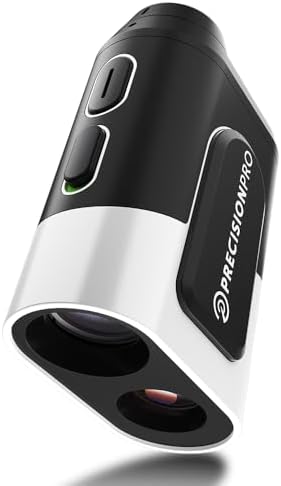
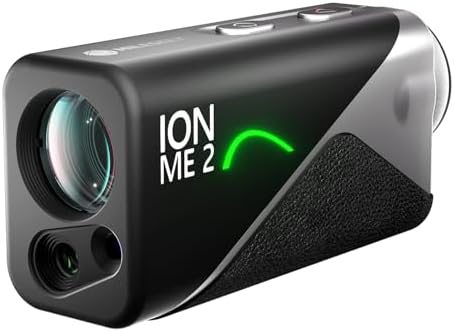
MILESEEY IONME2 Golf Rangefinder
If you prefer playing from a vehicle, see top-rated models for cart mounting.
$499.99 price checked August 2026

REDTIGER Range Finder Golf
$139.97 price checked August 2026
Read our full REDTIGER Range Finder review
To understand the technology better, browse different types of slope rangefinders.
Slope and Measurement Technology
Slope and measurement technology defines how the device calculates the difference between the flat ground and the actual incline of the terrain.
- Slope Compensation – This is the ability of the device to adjust the horizontal distance based on the angle of the hill. A higher compensation percentage (e.g., 10% or 15%) allows the device to account for steeper inclines.
- True Slope – This refers to a calculation based on the actual incline of the terrain rather than an estimate. True Slope provides the most accurate yardage for the specific angle of the hill you are facing.
- Estimated Slope – This calculation uses a mathematical formula based on the distance and elevation change to guess the incline. While faster, it may be less accurate than True Slope on extremely irregular terrain.
- Measurement Range – This is the maximum distance the laser can accurately lock onto a target. A higher number allows you to measure distances on longer holes, such as par 5s, without the device losing the target.
- Sensor Speed – This is the time it takes for the laser to calculate the distance and display it on the screen. A lower number (measured in milliseconds) means the device reacts faster as you move the unit.
- Target Locking – This refers to the software’s ability to distinguish between a flagstick and a nearby tree or person. A more advanced locking system prevents the device from displaying the distance to a nearby obstacle instead of the target.
Display and Power Specifications
Display and power specifications dictate how you interact with the data and how long the device remains functional during a round of golf.
- Display Type – This identifies the screen technology, such as monochromatic, dual-color (red/green), or full-color OLED. Full-color OLEDs offer the best visibility in direct sunlight and provide the clearest distinction between the distance and the slope.
- Battery Life – This is the number of rounds or shots the device can perform on a single charge. A higher number ensures you will not run out of power during an 18-hole round.
- Charging Type – This specifies how the device is powered, such as via a USB-C cable or replaceable batteries. USB-C is a modern standard that allows for faster charging and compatibility with common power banks.
- Holographic Display – This is a specific type of high-contrast display designed to be readable from various angles. It helps ensure the numbers are visible even when the unit is tilted.
Commonly Confused Terms
Buyers often confuse several terms regarding how slope and distance are calculated or displayed.
Slope vs. Elevation
Slope refers to the angle of the incline, while elevation refers to the height above sea level. A rangefinder uses the slope to tell you how many yards to add or subtract from the flat distance, whereas elevation is a static measurement of height.
Magnification vs. Field of View
Magnification and field of view have an inverse relationship. Higher magnification makes the target appear larger but narrows the area you can see, while a wider field of view allows you to see more of the landscape but makes the target appear smaller.
True Slope vs. Estimated Slope
True Slope measures the actual angle of the ground between you and the flag. Estimated Slope uses a formula based on the distance and the elevation change. True Slope is more accurate on complex terrain where the path to the flag is not a straight line.
Nitrogen Purging vs. Water Resistance
Nitrogen purging prevents internal fogging by removing moisture from the device. Water resistance (often rated by IP standards like IPX7) prevents external water from entering the device. A device can be water-resistant but still fog up internally if it is not nitrogen-purged.
Browse our other Golf Rangefinder pages
- Choosing the Best Golf Rangefinder with Slope for Beginners
- The Golf Rangefinders with Slope That Work Best for Budget Tournament Play
- Which Golf Rangefinder with Slope is Best for Long Distances?
- Best Golf Rangefinder with Slope for Cart Mounting
- Golf Rangefinders with Slope for Fast Flag Locking Compared
- Choosing the Best Golf Rangefinder with Slope for Accurate Yardages