A Schmidt-Cassegrain Telescope (SCT) is a type of catadioptric telescope that uses both mirrors and lenses to gather light and produce an image. It combines the light-gathering power of a large mirror with the compact, folded optical path of a lens-based system. This design allows a large primary aperture to fit into a tube that is significantly shorter than a traditional Newtonian or refractor telescope of the same size.
The primary problem an SCT solves is the physical limitation of telescope size. In traditional reflector telescopes, the length of the tube is tied directly to the focal length of the mirror. For large apertures, these tubes become unwieldy and difficult to transport. A Schmidt-Cassegrain telescope uses a curved primary mirror and a convex secondary mirror to fold the light path back on itself. This allows a user to achieve a long focal length—necessary for high-magnification views of planets and small lunar craters—within a portable, manageable frame.
How does a Schmidt-Cassegrain Telescope work?
A Schmidt-Cassegrain telescope works by reflecting and refracting light through a series of internal components in a specific sequence to focus an image.
- The light first enters the front of the telescope and passes through a corrector plate, which is a lens designed to eliminate spherical aberration.
- The light hits the primary mirror, located at the back of the telescope tube, which reflects the light toward the front of the device.
- A convex secondary mirror sits near the front of the tube and intercepts this light, reflecting it back down toward the primary mirror.
- The primary mirror reflects the light a second time, directing it through a hole in the center of the secondary mirror.
- The light passes through the hole and converges at a focal point located just behind the primary mirror, where the eyepiece or camera sensor is placed.
Schmidt-cassegrain Telescopes we have reviewed in detail
Prices across these 3 run from $1699 to $2999; each one has a full review here.

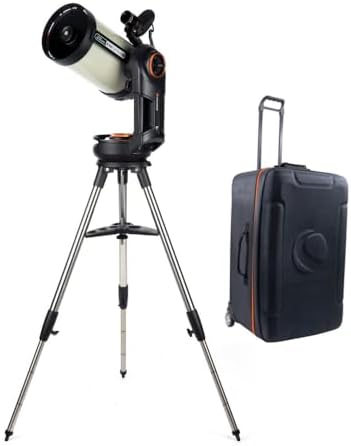
Celestron NexStar Evolution 8 EdgeHD
$2999 price checked August 2026
Modern users can compare the best schmidt-cassegrain telescope for smartphone control to see which models integrate with mobile apps.

Parts of a Schmidt-Cassegrain Telescope that matter to a buyer
Several specific components in a Schmidt-Cassegrain telescope determine the clarity and usability of the final image.
The Corrector Plate
The corrector plate is the glass surface at the very front of the telescope. Because the primary mirror is spherical rather than parabolic, it would naturally produce a blurry image. The corrector plate corrects this optical error, ensuring that light from the edges of the mirror converges at the same point as light from the center.
The Primary Mirror
The primary mirror is the large, concave mirror at the base of the tube. Its diameter, or aperture, determines how much light the telescope can collect. A larger primary mirror allows for better resolution and the ability to see fainter objects, but it also increases the weight and cost of the telescope.
The Secondary Mirror
The secondary mirror is a smaller, convex mirror located at the front of the tube. Its job is to fold the light path. By reflecting the light back toward the primary mirror, it allows the telescope to have a long focal length while keeping the physical tube length short.
For a clearer understanding of technical data, see our guide to SCT specs in plain English.
Focal Ratio and Focal Length
Focal ratio, often expressed as f/10 in many Schmidt-Cassegrain designs, describes the relationship between the focal length and the aperture. A high focal ratio like f/10 provides high magnification, making it ideal for planetary observation. However, it also means the telescope has a narrower field of view compared to “fast” telescopes like those with an f/5 or f/6 ratio.
What changes in practice when using a Schmidt-Cassegrain Telescope?
Owning a Schmidt-Cassegrain telescope changes the practical experience of observing by prioritizing portability and high-magnification detail over wide-field views.
Portability and Transport
Because the optical path is folded, you can transport a large-aperture telescope in a compact tube. This makes it easier to move between observing locations or store in a home compared to a large Newtonian reflector, which requires a long, heavy tube for the same aperture.
Planetary vs Deep-Sky Observation
The high focal length of an SCT makes it excellent for observing the Moon and planets. You will see sharp details on the surface of Mars or the rings of Saturn. However, because the field of view is narrow, these telescopes are less suited for large, faint nebulae or sprawling star clusters, which are better suited for “fast” focal ratio systems.
Thermal Equilibrium Time
A practical limitation of the Schmidt-Cassegrain telescope is the time it takes to reach thermal equilibrium. Because the primary mirror is large and sits inside a sealed tube, it takes time for the mirror to reach the same temperature as the outside air. If the mirror is too warm, it can cause “tube currents” or shimmering in the image, distorting the view of planets until the telescope has cooled sufficiently.
Who needs a Schmidt-Cassegrain Telescope?
A Schmidt-Cassegrain telescope is the right choice for specific types of observers based on their goals and physical constraints.
Planetary and Lunar Observers
You should consider a Schmidt-Cassegrain telescope if your primary goal is to see high-magnification details on the Moon, planets, and double stars. The inherent focal length of these systems provides the magnification needed for these targets without requiring complex focal reducers.
Users with Limited Storage Space
If you have limited space for storage but want a large aperture, this category is a practical choice. The compact design allows for easy storage in a closet or garage while still providing the light-gathering power of a much larger traditional reflector.
Who should avoid this category
You should avoid a Schmidt-Cassegrain telescope if you primarily want to photograph large, faint deep-sky objects like the Andromeda Galaxy or large nebulae. These targets require a wide field of view and a “fast” focal ratio, which these telescopes do not provide without significant and expensive accessories. Additionally, if you prefer a telescope that reaches thermal equilibrium instantly, a smaller refractor or a smaller Newtonian may be a better fit.
The other Schmidt-cassegrain guides we have published
- Which Schmidt-Cassegrain Telescope Is Best for Deep-Sky Astrophotography?
- Best Schmidt-Cassegrain Telescope for Beginners
- Schmidt-Cassegrain Telescopes with Smartphone Control Compared
- Choosing the Best Schmidt-Cassegrain Telescope for Easy Setup
- The Schmidt-Cassegrain Telescopes That Work Best for Deep Space
- Which Schmidt-Cassegrain Telescope Is Best for Small Spaces?