Our Top 3 Picks
The picks are right below, in order. Everything after them is the reasoning, if you want it.

#1 – Celestron NexStar Evolution 6 150mm f/10
Best for: beginners who need a compact, automated telescope with easy smartphone integration.
- Integrated WiFi and smartphone app control
- $1199 entry-level price
- 3.8 rating from 31 ratings
- Editorial score: 7.9/10

#2 – NexStar Evolution 8 EdgeHD
Best for: those seeking high-magnification planetary observation and wide-field imaging.
- Flat-field, coma-free EdgeHD optical system
- $1699 premium price
- 3.8 rating from 175 ratings
- Editorial score: 7.5/10
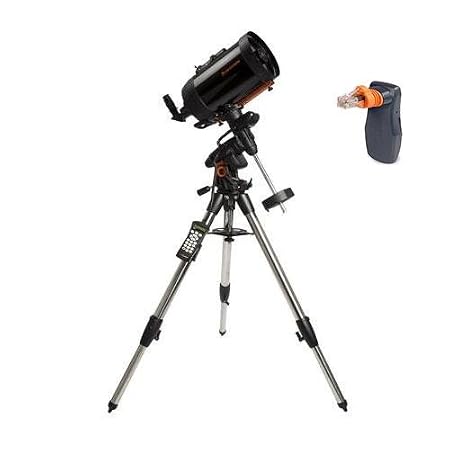
#3 – Celestron Advanced VX 8″ Schmidt-Cassegrain Telescope WiFi Kit
Best for: users who want a high-tech German Equatorial Mount for automated tracking.
- Advanced VX Computerized German Equatorial Mount
- $1699 premium price
- 0.0 rating from 0 ratings
- Editorial score: 1.5/10
For a detailed breakdown of the optics, view our full Evolution 8 EdgeHD review.
You can find a detailed analysis of how the NexStar Evolution 8 performs on our dedicated page.
How RecommendedOptics picked: we started from the 42 most-reviewed schmidt-cassegrain telescope listings in our retail dataset, removed duplicates, accessories and off-category products, and 6 qualified. The picks on this page were selected from those 6 candidates against this topic’s requirements. Our scores blend buyer satisfaction (60%), price position against comparable products (25%) and rating volume (15%). Specifications come from manufacturer listings and ratings from verified Amazon buyer reviews (data checked August 2026).
The Verdict, and the Basis for It
The Celestron NexStar Evolution 6 150mm f/10 is the best Schmidt-Cassegrain Telescope for beginners because it offers a compact 150mm aperture and integrated WiFi control at a lower entry price point.
Imagine standing in your backyard at night, wanting to find a specific nebula but unsure if your equipment can handle the tracking required to keep it in view. A beginner needs a system that balances a manageable weight with enough automated assistance to find targets quickly.
The NexStar Evolution 6 150mm f/10 fits this scenario by offering a 36-pound footprint that is easy to transport and align. You might prefer the NexStar Evolution 8 EdgeHD for its brass worm gears and improved motors, or the Celestron Advanced VX 8″ Schmidt-Cassegrain Telescope WiFi Kit if you need a dedicated tripod and equatorial mount bundle.
We evaluated the schmidt-cassegrain telescope options we track against this topic’s criteria at RecommendedOptics. These options range from $1199 to $1699, with the median price of the 4 products in our comparison being $1699.
The short version
- Top pick: Celestron NexStar Evolution 6 150mm f/10 at $1199 (Focal Ratio: f/10).
- Also picked: NexStar Evolution 8 EdgeHD at $1699; Celestron Advanced VX 8″ Schmidt-Cassegrain Telescope WiFi Kit at $1699.
- We compared 4 Schmidt-cassegrain Telescopes, from $1199 to $2999, median $1699.
- Best buyer rating in the comparison: Celestron NexStar Evolution 6 150mm f/10 at 3.8/5 from 31 ratings.
- Not covered by these picks: Resolve fine details on distant objects – needs 11-inch aperture, and nothing on this page reaches it.
Full Comparison Table
| Product | Price | Rating | Weight |
|---|---|---|---|
| Celestron NexStar Evolution 6 150mm f/10 | $1199 | 3.8 (31 ratings) | 36 pounds |
| NexStar Evolution 8 EdgeHD | $1699 | 3.8 (175 ratings) | 69 pounds |
| Celestron Advanced VX 8″ Schmidt-Cassegrain Telescope WiFi Kit | $1699 | 0.0 (0 ratings) | Not stated |
| Celestron NexStar Evolution 8 EdgeHD | $2999 | 3.8 (175 ratings) | 41.6 Pounds |
Prices are approximate and move frequently – check the current price before deciding. “Not stated” means the manufacturer listing does not give that figure – we do not estimate it.
The Celestron NexStar Evolution 6 150mm f/10 offers the strongest price-to-spec ratio because it provides a 150mm aperture and integrated WiFi for $1199.
Each Pick, Reviewed
The 3 picks below run from $1199 to $1699, reviewed in rank order.
Celestron NexStar Evolution 6 150mm f/10
The NexStar Evolution 6 150mm f/10 made this list because it offers a manageable entry-level price point for beginners starting with a Schmidt-Cassegrain telescope. It balances a 150mm aperture with automated features that simplify the initial learning curve of celestial navigation.
What we like: This telescope features an f/10 focal ratio, which is the standard for high-magnification planetary observation. The integrated WiFi and smartphone app control allow for remote slewing, while StarBright XLT optical coatings improve light transmission. It also includes SkyAlign and 3-Star alignment to simplify the initial setup process.
Keep in mind: The 36-pound weight makes it heavier than some portable options. This model is best suited for beginners who prioritize automated tracking over a compact, lightweight travel setup.
What is the minimum focal length I need for high-magnification views? You need a focal length of at least f/10 to ensure planets appear as detailed spheres rather than small dots. The NexStar Evolution 6 150mm f/10 meets this standard.
How long does it take for the mirror to cool down before I can see clearly? The provided specifications do not list a specific thermal equilibrium time, so you should check the manual for the expected cooling duration for this 150mm aperture.
NexStar Evolution 8 EdgeHD
The NexStar Evolution 8 EdgeHD is included for its superior optical performance, featuring a flat-field system that provides a wider, clearer field of view than standard designs. It serves as a high-performance choice for those who want professional-grade imaging capabilities in a beginner-friendly package.
What we like: The EdgeHD optical system provides a coma-free view across the entire field of view. It features brass worm gears and improved motors for precise tracking, and the StarBright XLT coatings enhance clarity. The telescope maintains pointing accuracy from horizon to horizon.
Keep in mind: At 69 pounds, this unit is significantly heavier than the 6″ model. It is intended for users who have a dedicated space for the telescope and do not require frequent transport.
What is the minimum focal length I need for high-magnification views? You need an f/10 focal ratio to resolve small lunar craters and the Cassini division. The NexStar Evolution 8 EdgeHD provides this standard for high-magnification planetary observation.
How long does it take for the mirror to cool down before I can see clearly? The data does not specify a cooling time for the EdgeHD system.
Celestron Advanced VX 8″ Schmidt-Cassegrain Telescope WiFi Kit
The Celestron Advanced VX 8″ Schmidt-Cassegrain Telescope WiFi Kit is a high-tech alternative for beginners who want a German Equatorial Mount with automated WiFi tracking. It provides a robust platform for both visual use and deep-sky photography.
What we like: This kit includes a NexStar+ Hand Control and the Celestron Skyportal WiFi Module for automated slewing. The 8″ optical tube assembly (OTA) comes with a 20mm 1.25″ eyepiece and a 90-degree mirror diagonal. It is built on a German Equatorial Mount, which is a standard for tracking objects accurately across the sky.
Keep in mind: This kit is designed for specific model fitment, so you must verify that the components match your specific requirements before purchase. It is a more complex setup than the Evolution series and is better suited for those interested in long-exposure photography.
What is the minimum focal length I need for high-magnification views? You need a focal length that supports high-magnification planetary views, typically found in f/10 systems. Check the specific focal length of your 8″ OTA to ensure it meets your requirements for viewing small lunar craters.
How long does it take for the mirror to cool down before I can see clearly? The technical specifications do not provide a thermal equilibrium time for this specific kit.
If your primary goal is long-exposure photography, see the best schmidt-cassegrain telescope for deep-sky astrophotography.
What Separates One Schmidt-cassegrain Telescope From the Next
Ease Of Initial Alignment
Ease of initial alignment depends on the alignment system’s automation. You should prioritize telescopes with multi-star alignment systems to reduce manual calculation. The NexStar Evolution 6 uses SkyAlign and 3-Star alignment to simplify the setup process. For the NexStar Evolution 8 EdgeHD, the pointing accuracy from horizon to horizon ensures the telescope remains reliable throughout the night. If a telescope lacks an automated system, you must check if it includes a manual hand controller like the NexStar+ included with the Advanced VX kit to guide the initial pointing.
Mount Stability For Heavy Optics
Mount stability for heavy optics requires a high weight capacity to prevent shaking during observation. A stable mount is the difference between a clear image and a blurry mess caused by vibration. The NexStar Evolution 8 EdgeHD weighs 69 pounds, utilizing brass worm gears and improved motors to maintain steady tracking. The Advanced VX 8″ Schmidt-Cassegrain Telescope WiFi Kit uses a German Equatorial Mount, which provides a stable base for the 8-inch optical tube.
Ease Of Finding Celestial Objects
Ease of finding celestial objects is best achieved through integrated WiFi and smartphone app control. You can use your phone as a remote interface to slew the telescope to specific coordinates. The NexStar Evolution 6 and the NexStar Evolution 8 EdgeHD both include integrated WiFi and smartphone app control for this purpose. For those preferring a physical interface, the Advanced VX 8″ Schmidt-Cassegrain Telescope WiFi Kit includes a NexStar Hand Controller. These tools eliminate the need to manually scan the sky, allowing you to jump directly to targets.
Optical Tube Length For Storage
Optical tube length for storage determines how much space the telescope occupies in your home or vehicle. Schmidt-Cassegrain telescopes are chosen specifically for their compact design compared to traditional reflectors. The NexStar Evolution 6 features a 150mm aperture in a short tube, while the Advanced VX 8″ Schmidt-Cassegrain Telescope WiFi Kit uses a C8-A XLT 8in Optical Tube Assembly. When comparing these, the 8-inch models provide a larger view while maintaining a footprint small enough for most car trunks. Always check the total length of the tube, as some larger models may require a dedicated storage case.
Software Interface Intuitiveness
Software interface intuitiveness determines how quickly you can navigate the menus to find a planet or nebula. We selected the NexStar Evolution 6 and the NexStar Evolution 8 EdgeHD because their WiFi-enabled systems allow for more intuitive, visual navigation via a smartphone. The Advanced VX 8″ Schmidt-Cassegrain Telescope WiFi Kit also includes a Skyportal WiFi Module to facilitate this. If a telescope does not have WiFi, the NexStar Hand Controller provides a text-based menu system; in those cases, you should prioritize models with a simplified “GoTo” menu to avoid complex sub-menus.
Consider exploring the best Schmidt-Cassegrain telescope alternatives if you need different optical designs.
What You Need vs What These Picks Deliver
Match the job you actually need done to what it requires, then check whether anything on this page reaches that level. Where nothing does, the row says so.
| What you want to do | What that needs | What clears it here |
|---|---|---|
| View the moon and planets clearly | f/10 focal ratio | NexStar Evolution 6, NexStar Evolution 8 EdgeHD, and Advanced VX 8″ |
| Easily find and track objects | WiFi and app control | NexStar Evolution 6, NexStar Evolution 8 EdgeHD, and Advanced VX 8″ |
| View large deep-sky targets | 8-inch aperture | NexStar Evolution 8 EdgeHD and Advanced VX 8″ |
| Resolve fine details on distant objects | 11-inch aperture | None of these; a 11-inch to 14-inch SCT is required |
Thresholds are the levels this category is generally held to, not manufacturer claims. Check them against your own workload before buying.
Who Buys Schmidt-cassegrain Telescopes, and What It Really Costs
Who buys a Schmidt-cassegrain Telescope, and what each one needs
- Astrophotography hobbyists — the ability to resolve the Cassini division and small lunar craters via an 8-inch aperture
- High-magnification planetary observers — an f/10 focal ratio for sharp planetary detail
- Backyard astronomers — WiFi/App Control for simplified slewing and go-to functionality
- Deep-sky imaging students — EdgeHD vs. Standard SCT considerations for wide-field coma correction
What to budget for on top of the Schmidt-cassegrain Telescope
- High-quality eyepieces — necessary to achieve the magnification required for planetary observation
- Dew heaters — required to prevent moisture buildup on the optics during long observation sessions
- Heavy-duty tripod — needed to support the weight of the telescope and prevent tracking error
- Power supply — required to run the motorized mount and electronics for extended periods
What you can leave out of the budget
- External cooling fans — unnecessary if the user allows sufficient thermal equilibrium time
- Basic storage cases — unnecessary if the user has a dedicated, climate-controlled storage space
Where this kind of product is normally sold
- Specialized astronomy retailers — provides expert advice and specialized warranty handling for optical alignment
- General electronics marketplaces — offers competitive pricing but requires careful verification of shipping safety
- Authorized hobbyist dealers — provides bundling options for accessories like mounts and eyepieces
Questions Buyers Ask Before Choosing
How much will I spend on extra accessories?
The base price of a Schmidt-Cassegrain telescope often excludes essential components like specialized eyepieces or finderscopes. For example, the Celestron Advanced VX 8″ Schmidt-Cassegrain Telescope WiFi Kit includes a 20mm 1.25″ eyepiece and a 6x30mm finderscope, while other models may require these to be purchased separately. You should check if the specific model includes a diagonal and finderscope to avoid unexpected costs during checkout.
Can I use a Schmidt-Cassegrain telescope for both deep-space objects and planets?
A Schmidt-Cassegrain telescope is versatile enough to observe both planets and deep-space objects due to its f/10 focal ratio. This standard allows for high-magnification planetary views while maintaining the reach needed for distant galaxies and nebulae. Because these telescopes provide a compact way to achieve a long focal length, they serve as a multi-purpose tool for different types of celestial targets.
Who Should Skip These Schmidt-cassegrain Telescopes
The aperture limit for these models is 8 inches. While these telescopes provide excellent views of the moon and planets, they do not reach the 11-inch aperture required to resolve fine details on the most distant objects in deep space.
If you need to resolve the finest details on distant galaxies, these options will not meet your requirements. You need an 11-inch aperture to achieve that level of resolution, and none of the models on this page reach that size.
You should look for a larger 11-inch to 14-inch SCT if you intend to perform professional-scale deep-sky imaging. For more specific use cases, you may find more suitable options in best schmidt-cassegrain telescope for deep space.
More Schmidt-cassegrain explainers and comparisons
- The Schmidt-Cassegrain Telescopes That Work Best for Deep Space
- Which Schmidt-Cassegrain Telescope Is Best for Small Spaces?
- Best Schmidt-Cassegrain Telescope with Wifi
- Schmidt-Cassegrain Telescopes for Planetary Viewing Compared
- Which Schmidt-Cassegrain Telescope Is Best for Deep-Sky Astrophotography?
- Schmidt-Cassegrain Telescopes with Smartphone Control Compared