Our Top 3 Picks
You are not here to run a research project. You are here to find a Schmidt-cassegrain Telescope that works and get on with it – these 3 are the ones we picked.

#1 – Celestron CGEM II 800 EdgeHD 8″
Best for: users prioritizing specialized support and high-end optical clarity for deep-space imaging.
- No additional cost for repairs, parts, labor, and shipping
- $3,399 (premium)
- 4.5 rating from 4 ratings
- Editorial score: 6.1/10
Weight: 5.5 pounds
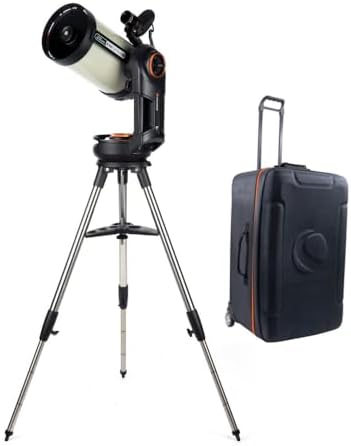
#2 – Celestron NexStar Evolution 8 EdgeHD
Best for: upgraders who need a heavy-duty fork mount with StarBright XLT coatings.
- EdgeHD optical system with brass worm gears
- $2,999 (premium)
- 3.8 rating from 175 ratings
- Editorial score: 6.7/10
Weight: 41.6 Pounds

#3 – Celestron NexStar Evolution 8 WiFi
Best for: users seeking a portable, WiFi-enabled setup with a long-lasting internal battery.
- 10-hour lithium iron phosphate (LiFePO4) battery
- $1,699 (mid)
- 3.8 rating from 175 ratings
- Editorial score: 7.5/10
Weight: 38.5 pounds
For a more compact option, view our full NexStar Evolution 6 spec breakdown to see how it performs.
How RecommendedOptics picked: we started from the 42 most-reviewed schmidt-cassegrain telescope listings in our retail dataset, removed duplicates, accessories and off-category products, and 6 qualified. The picks on this page were selected from those 6 candidates against this topic’s requirements. Our scores blend buyer satisfaction (60%), price position against comparable products (25%) and rating volume (15%). Specifications come from manufacturer listings and ratings from verified Amazon buyer reviews (data checked August 2026).
Our Verdict and How We Chose
The Celestron CGEM II 800 EdgeHD 8″ is the best Schmidt-Cassegrain Telescope for deep space because its EdgeHD optics provide superior clarity across the entire field of view.
Choosing a new Schmidt-Cassegrain telescope often leads to over-investing in a mount while sacrificing the optical clarity needed to resolve faint deep-space targets. If the primary mirror lacks advanced correction, images of distant galaxies will appear distorted at the edges of the frame.
The Celestron CGEM II 800 EdgeHD 8″ solves this by utilizing EdgeHD optics for uniform sharpness. You should choose the NexStar Evolution 8 EdgeHD if you need a heavier, more robust fork-mounted system, or the NexStar Evolution 8 WiFi if you prefer a portable, battery-powered setup with mobile app integration.
At RecommendedOptics we evaluated the schmidt-cassegrain telescope options we track against this topic’s criteria. The selected models cover a price range from $1699 to $3399, with a median price of $1699.
What the data says
- Top pick: Celestron CGEM II 800 EdgeHD 8″ at $3399 (Weight: 5.5 pounds).
- Also picked: Celestron NexStar Evolution 8 EdgeHD at $2999; Celestron NexStar Evolution 8 WiFi at $1699.
- We compared 6 Schmidt-cassegrain Telescopes, from $1199 to $3399, median $1699.
- Best buyer rating in the comparison: Celestron NexStar Evolution 8 EdgeHD at 3.8/5 from 175 ratings.
- Not covered by these picks: Track deep-space targets with high precision – needs < 1.0 arcsecond periodic error, and nothing on this page reaches it.
Full Comparison Table
| Product | Price | Rating | Weight |
|---|---|---|---|
| Celestron CGEM II 800 EdgeHD 8″ | $3399 | 4.5 (4 ratings) | 5.5 pounds |
| Celestron NexStar Evolution 8 EdgeHD | $2999 | 3.8 (175 ratings) | 41.6 Pounds |
| Celestron NexStar Evolution 8 WiFi | $1699 | 3.8 (175 ratings) | 38.5 pounds |
| Celestron NexStar Evolution 6 150mm f/10 | $1199 | 3.8 (31 ratings) | 36 pounds |
| NexStar Evolution 8 EdgeHD | $1699 | 3.8 (175 ratings) | 69 pounds |
| Celestron Advanced VX 8″ Schmidt-Cassegrain Telescope WiFi Kit | $1699 | 0.0 (0 ratings) | Not stated |
Prices are approximate and move frequently – check the current price before deciding. “Not stated” means the manufacturer listing does not give that figure – we do not estimate it.
The Celestron NexStar Evolution 8 EdgeHD offers the strongest price-to-spec ratio because it combines EdgeHD optics with a 41.6-pound weight for deep space tracking.
The Picks Reviewed in Detail
The 3 picks below run from $1699 to $3399, reviewed in rank order.
Celestron CGEM II 800 EdgeHD 8″
The Celestron CGEM II 800 EdgeHD 8″ is our top choice for deep space because it combines the EdgeHD optical system with a high-end mount designed for maximum clarity. It is built for users who need the precision of professional-grade optics to resolve distant galaxies.
What we like: The EdgeHD optical system provides a flat field of view, which is essential for wide-field deep-sky imaging. This model also includes a comprehensive support package with 24/7 expert access for setup and troubleshooting. The 8-inch aperture meets the 8-inch threshold required to resolve the Cassini division and small lunar craters.
Keep in mind: At $3,399, this is the highest-priced option and may be outside the budget of those looking for a basic entry into Schmidt-Cassegrain optics. The weight of 5.5 pounds for the tube is manageable, but the overall system requires a stable base for long-exposure tracking.
Celestron NexStar Evolution 8 EdgeHD
We selected the Celestron NexStar Evolution 8 EdgeHD for users who want a heavy-duty mount and premium optics in a single bundle. It provides a significant upgrade for those moving from standard SCTs to high-magnification planetary and deep-sky observation.
What we like: This model features StarBright XLT optical coatings and brass worm gears for improved tracking accuracy. The bundle includes the Starsense Telescope and an optical tube carrying case, adding significant value to the $2,999 price point. It uses the EdgeHD system to ensure consistent image quality across the entire field of view.
Keep in mind: The 41.6-pound weight makes this unit less portable than other options, which may limit its use for those who need to move the telescope frequently. It is best suited for a permanent backyard setup rather than frequent travel.
Celestron NexStar Evolution 8 WiFi
The Celestron NexStar Evolution 8 WiFi serves as the ideal mid-range choice, offering modern connectivity and a compact form factor for backyard use. It is designed for users who want the convenience of app-based control for locating deep-space objects.
What we like: This telescope includes a 10-hour lithium iron phosphate (LiFePO4) battery and WiFi functionality for use with the SkyPortal app on iOS and Android. It features the StarBright XLT coatings and brass worm gears for reliable tracking. At $1,699, it offers a high level of technology for a lower price point than the EdgeHD models.
Keep in mind: Because it lacks the EdgeHD optical system, users looking for perfectly flat wide-field imaging may find the field of view less consistent than the higher-end models. The 38.5-pound weight still requires a sturdy surface for stable operation.
The Specs That Decide This Purchase
Aperture For Faint Objects
Aperture for faint objects dictates how much light a telescope gathers, which is the primary requirement for deep space targets. You should prioritize an 8-inch aperture as the baseline for serious amateur observation, as it is the point where a telescope can resolve the Cassini division and small lunar craters. All three models—the Celestron CGEM II 800 EdgeHD 8″, the Celestron NexStar Evolution 8 EdgeHD, and the Celestron NexStar Evolution 8 WiFi—feature 8-inch apertures to ensure sufficient light collection for faint galaxies and nebulae. If you need more light than these offer, you would need to move into the 11-inch to 14-inch SCT reference tier, though these models provide a high-performance starting point for deep-space imaging.
Edge-Illuminated Optics
Edge-illuminated optics determine the usable field of view and image clarity across the entire mirror surface. The EdgeHD optical system in the Celestron CGEM II 800 EdgeHD 8″ and the Celestron NexStar Evolution 8 EdgeHD provides a flatter field compared to a standard SCT, which is critical for wide-field deep-sky imaging. While the Celestron NexStar Evolution 8 WiFi uses a standard 8-inch Schmidt-Cassegrain optical tube, the EdgeHD versions separate the field by providing superior coma correction. When upgrading, choosing an EdgeHD system allows you to capture sharper images toward the edges of the frame without the distortion found in older, non-corrected designs.
Tracking Precision
Tracking precision is the difference between a sharp image and a blurry trail of stars during long exposures. For deep space, a high-quality computerized GoTo mount is essential, as the mount is often as much of an investment as the telescope itself. The Celestron CGEM II 800 EdgeHD 8″ provides a heavy-duty foundation for stability, while the NexStar Evolution 8 EdgeHD includes brass worm gears and improved motors to maintain steady tracking. If your current mount causes periodic error that trails stars, upgrading to a fork-mounted system with these heavy-duty components ensures the telescope stays locked on faint targets for longer durations.
Focal Ratio Suitability
Focal ratio suitability determines whether the telescope is “fast” enough for specific astrophotography goals. A standard SCT typically has a slower focal ratio, whereas “fast” versions are designed to capture wider fields more quickly. The f/10 focal ratio is the standard for high-magnification planetary observation and deep-sky imaging. Because these models sit at this standard, they are excellent for high-detail work; however, if your goal is extremely wide-field deep space photography, you must check the specific focal length of the optical tube to ensure it matches your intended framing. The Celestron NexStar Evolution 8 WiFi offers a more accessible entry point for this standard at the $1699 mark.
Learning about the different designs is easy if you explore the types of Schmidt-Cassegrain Telescopes available today.
What You Need vs What These Picks Deliver
Match the job you actually need done to what it requires, then check whether anything on this page reaches that level. Where nothing does, the row says so.
| What you want to do | What that needs | What clears it here |
|---|---|---|
| Track deep-space targets with high precision | < 1.0 arcsecond periodic error | none of our picks (requires a high-end equatorial mount like the Meade LX200 series) |
| Resolve large deep-sky targets with high magnification | f/10 focal ratio | CGEM II 800 EdgeHD, NexStar Evolution 8 EdgeHD, NexStar Evolution 8 WiFi |
| Resolve fine details on distant galaxies | 8-inch aperture | CGEM II 800 EdgeHD, NexStar Evolution 8 EdgeHD, NexStar Evolution 8 WiFi |
Thresholds are the levels this category is generally held to, not manufacturer claims. Check them against your own workload before buying.
Who Buys Schmidt-cassegrain Telescopes, and What It Really Costs
Who buys a Schmidt-cassegrain Telescope, and what each one needs
- Astrophotography hobbyists — 8-inch aperture to resolve the Cassini division and small lunar craters
- Deep-sky imaging specialists — f/10 focal ratio for high-magnification planetary observation
- Wide-field imaging researchers — EdgeHD vs. Standard SCT formats for coma correction
- Serious amateur astronomers — 11-inch to 14-inch SCTs as the benchmark for large-scale deep-sky targets
What to budget for on top of the Schmidt-cassegrain Telescope
- Computerized equatorial mount — required to correct tracking error and periodic error for long-exposure photography
- High-power eyepieces — necessary to achieve the magnification required for planetary observation
- Dew heaters — required to manage thermal equilibrium time and prevent moisture on the optics
- Power supply station — needed to run the motorized slewing and go-to functionality for long sessions
What you can leave out of the budget
- Entry-level terrestrial binoculars — unnecessary when the telescope provides superior magnification for deep space
- Basic hand controllers — skippable if the telescope supports WiFi/App Control for slewing
- Generic lens filters — unnecessary if the primary mirror is properly managed for thermal equilibrium
Where this kind of product is normally sold
- Specialized astronomy retailers — provide expert bundling and specialized warranty handling for complex optics
- Authorized electronics distributors — offer standard return windows and reliable shipping for heavy equipment
- Online marketplaces — provide competitive pricing but require careful verification of shipping insurance for large mirrors
If you prefer mobile integration, find the best schmidt-cassegrain telescope for smartphone control to streamline your viewing experience.
Buying Questions Answered
How long does it take for the primary mirror to cool down before I can start observing?
Thermal equilibrium time depends on the specific telescope’s thermal mass, as a mirror must reach ambient temperature to prevent image distortion. Because the Celestron NexStar Evolution 8 WiFi and EdgeHD models utilize 8-inch Schmidt-Cassegrain optics, you should check the manufacturer’s specific cooling time for the optical tube to ensure clarity before starting your session.
Will I need to buy extra accessories like a Barlow lens or a specific camera adapter to use it?
Additional costs for essential optics like Barlow lenses or camera adapters are often required depending on your specific imaging setup. The Celestron NexStar Evolution 8 HD With Starsense Telescope bundle includes specific accessories, but you should verify if your required focal length or sensor fit requires a separate adapter or lens.
Which Schmidt-Cassegrain telescope should I choose for my specific needs?
If you require the highest optical precision for deep-space targets, the Celestron CGEM II 800 EdgeHD 8″ is the choice for its EdgeHD optics and 5.5-pound weight. Users seeking a balance of features might prefer the Celestron NexStar Evolution 8 WiFi, which includes a 10-hour LiFePO4 battery and WiFi functionality for around $1699.
Is the Celestron NexStar Evolution 8 WiFi worth the investment for an upgrader?
Upgraders seeking modern connectivity should consider the Celestron NexStar Evolution 8 WiFi for its integrated WiFi and SkyPortal app compatibility. At the $1699 mark, it provides a significant technological leap over older manual models while maintaining the 8-inch Schmidt-Cassegrain optical tube.
Who Should Skip These Schmidt-cassegrain Telescopes
If you require a telescope that can track deep-space targets with a periodic error under 1.0 arcsecond, none of these models meet that requirement. The precision of these mounts is intended for general deep-space observation rather than high-precision long-exposure photography.
If your priority is high-resolution astrophotography rather than visual observation, you should look at best schmidt-cassegrain telescope for deep-sky astrophotography. For users who need a more portable setup for travel or limited space, provides alternative options.
Every Schmidt-cassegrain guide in this category
- Best Schmidt-Cassegrain Telescope for Beginners
- Schmidt-Cassegrain Telescopes with Smartphone Control Compared
- Choosing the Best Schmidt-Cassegrain Telescope for Easy Setup
- Which Schmidt-Cassegrain Telescope Is Best for Small Spaces?
- Best Schmidt-Cassegrain Telescope with Wifi
- Schmidt-Cassegrain Telescopes for Planetary Viewing Compared