There are three meaningfully different types of Schmidt-Cassegrain telescopes defined by their optical engineering and intended use. While all utilize a primary mirror and a secondary corrector lens to create a compact tube, the specific configuration of the corrector and the primary mirror’s curvature determines whether the telescope excels at high-magnification planetary work, wide-field deep-sky imaging, or portable observation.
What is a Standard Schmidt-Cassegrain Telescope?
A standard Schmidt-Cassegrain telescope defines the baseline for this category by using a spherical primary mirror and a corrector plate at the front of the tube. This design allows the telescope to remain compact because the light path is folded, making it much shorter than a Newtonian of the same aperture. You should choose a standard Schmidt-Cassegrain telescope if you need a versatile, all-purpose instrument that performs well across various targets.
Performance of Standard Schmidt-Cassegrain Models
The standard Schmidt-Cassegrain telescope offers a compact footprint that makes it easier to transport and mount than many other large-aperture designs. It provides a long focal length, which is ideal for high-magnification views of the moon and planets. Because the primary mirror is spherical rather than parabolic, these units often provide a larger field of view than some other catadioptric designs.
Limitations of Standard Schmidt-Cassegrain Designs
Standard Schmidt-Cassegrain telescopes require a significant amount of time to reach thermal equilibrium. Because the primary mirror is large and the tube is enclosed, the glass can take considerable time to match the outside air temperature. If the mirror is too warm, it creates internal heat currents that distort the image. This type of telescope also has a slower focal ratio, which may not be the fastest option for wide-field photography.
Where these choices show up in our reviews
Prices across these 3 run from $1199 to $2999; each one has a full review here.
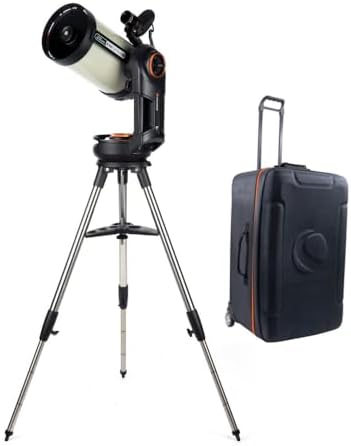

Celestron NexStar Evolution 8 WiFi
If you want to automate your tracking, find the best schmidt-cassegrain telescope for smartphone control in our comparison.
$1699 price checked August 2026

What is an Edge-Corrected Schmidt-Cassegrain Telescope?
An edge-corrected Schmidt-Cassegrain telescope uses additional aspheric corrector lenses to flatten the field of view across the entire image. While a standard model may show distortion or “coma” near the edges of the frame, an edge-corrected version maintains sharpness from the center to the periphery. This type is designed for users who prioritize high-quality wide-field imaging over simple visual observation.
Imaging Capabilities of Edge-Corrected Models
Edge-corrected Schmidt-Cassegrain telescopes allow for much larger sensor sizes to be used without sacrificing corner detail. This makes the telescope a strong candidate for capturing large nebulae or expansive star clusters. By correcting the optical aberrations inherent in the standard design, these telescopes provide a more usable field of view for astrophotography.
Selecting the right optics is easier when you understand the focal ratio for Schmidt-Cassegrain telescopes before buying.
Price and Complexity of Edge-Corrected Designs
Edge-corrected Schmidt-Cassegrain telescopes sit at a higher price point than standard models due to the complex manufacturing of the extra corrector lenses. The internal optical path is more complex, which can also lead to a slightly more demanding setup process. You are paying a premium for the ability to use large cameras without the image falling apart at the edges of the frame.
What is a Compact Schmidt-Cassegrain Telescope?
A compact Schmidt-Cassegrain telescope is defined by a smaller aperture and a shorter tube length designed for maximum portability. These units often use smaller primary mirrors, typically in the 6-inch to 8-inch range, to ensure the telescope can be moved easily by a single person. This type is for the user who prioritizes mobility and ease of setup over the ability to resolve the smallest details of distant galaxies.
Portability of Compact Schmidt-Cassegrain Models
Compact Schmidt-Cassegrain telescopes are the easiest to transport to dark-sky sites. Because they are smaller, they require less stable mounting and are less susceptible to wind than larger tubes. They provide a “grab-and-go” experience where the time spent on assembly is minimized, allowing more time for actual observation.
Aperture Limits of Compact Designs
Compact Schmidt-Cassegrain telescopes have a smaller light-gathering area, which limits their ability to see very faint objects. While they are excellent for the moon, planets, and bright deep-sky targets, they cannot resolve the same level of detail as larger aperture systems. These units sit at the lower end of the price spectrum compared to larger or edge-corrected versions.
Comparison of Schmidt-Cassegrain Telescope Types
| Telescope Type | Best-Fit Buyer | Main Advantage | Main Compromise |
|---|---|---|---|
| Standard SCT | General purpose visual observers | Compact size for high-magnification | Long thermal equilibrium time |
| Edge-Corrected SCT | Wide-field astrophotographers | Flat field across the entire image | Higher cost and complexity |
| Compact SCT | Mobile and beginner observers | Maximum portability and ease of use | Limited light-gathering power |
How do you know which Schmidt-Cassegrain telescope type fits your needs?
You can determine which Schmidt-Cassegrain telescope type fits your needs by identifying your primary objective and your tolerance for setup time. If your goal is to capture large areas of the sky with a large camera sensor, an edge-corrected Schmidt-Cassegrain telescope is the correct choice. If you want a versatile tool for looking at the moon and planets from a fixed location, a standard Schmidt-Cassegrain telescope provides the best balance of features.
Conditions for choosing a standard model
A standard Schmidt-Cassegrain telescope is right for you if you primarily use the telescope for visual observation or high-magnification planetary work. You should choose this if you have the patience to let the telescope cool down to ambient temperature before your main viewing session. This is the most common choice for those who want a “do-it-all” telescope without the premium price of edge correction.
Conditions for choosing an edge-corrected model
You need an edge-corrected Schmidt-Cassegrain telescope if you plan to spend significant time on deep-sky photography with large sensors. If you find that your current images are blurry or distorted at the corners, this type of telescope will solve that specific problem. This choice is for the user who prioritizes the final image quality over the initial cost of the optics.
Conditions for choosing a compact model
A compact Schmidt-Cassegrain telescope is the right choice if you frequently travel to different locations and need to transport your gear alone. If you prefer a quick setup and are satisfied with observing bright objects like the moon and planets, the compact version offers the best mobility. Choose this if you want to minimize the weight and size of your equipment while still keeping the benefits of a folded optical path.
Browse our other Schmidt-cassegrain pages
- The Schmidt-Cassegrain Telescopes That Work Best for Deep Space
- Which Schmidt-Cassegrain Telescope Is Best for Small Spaces?
- Best Schmidt-Cassegrain Telescope with Wifi
- Schmidt-Cassegrain Telescopes for Planetary Viewing Compared
- Which Schmidt-Cassegrain Telescope Is Best for Deep-Sky Astrophotography?
- Best Schmidt-Cassegrain Telescope for Beginners