Focal ratio in a Schmidt-Cassegrain telescope is expressed as an f/number, representing the ratio of the telescope’s focal length to its aperture diameter. Your choice of focal ratio depends entirely on whether you prioritize wide-field views of large constellations or high-magnification views of small, distant objects.
Which Focal Ratio Suits Your Astronomy Goals?
| If this is you | The Focal Ratio that suits you | Why |
|---|---|---|
| You want to capture large nebulae or wide star fields in a single frame. | f/6 to f/7 | A lower focal ratio provides a wider field of view, making it easier to frame large celestial structures. |
| You primarily observe the moon and planets for visual use. | f/10 to f/12 | A higher focal ratio provides the magnification needed to see surface details on planets and lunar craters. |
| You are a beginner who wants a versatile, all-purpose telescope. | f/10 | The f/10 ratio is a standard balance that performs well for both lunar observation and deep-sky targets. |
| You intend to do high-resolution astrophotography of small galaxies. | f/10 or higher | Longer focal lengths allow for better resolution of smaller, more distant targets, provided your mount can track accurately. |
| You want to observe large clusters and the Milky Way core. | f/6.5 or lower | A “fast” telescope (lower f-number) gathers light across a wider area, which is necessary for faint, extended objects. |
Reviewed examples from this category
Prices across these 3 run from $1699 to $2999; each one has a full review here.

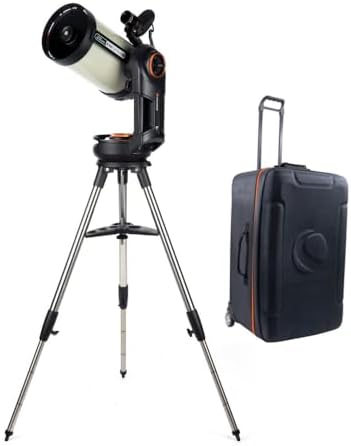
Celestron NexStar Evolution 8 EdgeHD
$2999 price checked August 2026
Read our full NexStar Evolution 8 review
If you prefer remote operation, see the best schmidt-cassegrain telescope for smartphone control.

How Do I Measure or Verify the Focal Ratio?
The focal ratio of a Schmidt-Cassegrain telescope is almost always printed on the manufacturer’s specification sheet or engraved on the telescope tube itself.
Locating the focal ratio number
Look for a value labeled “f/” followed by a number, such as f/10 or f/7. This number is usually found on a sticker near the eyepiece holder or near the primary mirror housing.
Calculating the focal ratio manually
If the focal ratio is not listed, you can calculate it by dividing the focal length by the aperture diameter. For example, if a telescope has a 2000mm focal length and a 200mm aperture, the calculation is 2000 divided by 200, resulting in an f/10 ratio.
You can find the focal length in millimeters (mm) and the aperture diameter in millimeters (mm) on the manufacturer’s website or the product’s physical documentation. Ensure both measurements use the same units before performing the division.
Understanding the physical dimensions is key, so research the ideal tube length for Schmidt-Cassegrain telescopes.
What Happens if I Choose the Wrong Focal Ratio?
Choosing a focal ratio that does not match your intended use results in specific visual or technical limitations during your observation time.
The effects of a focal ratio that is too low
If you choose an f/6 or f/7 telescope when you primarily want to see the details of Jupiter or Saturn, the image will appear too small in the eyepiece. You would need to use extremely high-power eyepieces, which can result in a dim image and a very narrow field of view that makes it difficult to find your target.
The effects of a focal ratio that is too high
If you choose an f/12 or f/15 telescope for wide-field photography or viewing large nebulae, the target may be too large to fit into the frame. You may find that you can only see a small portion of a galaxy at a time, and the image may appear “zoomed in” beyond what is useful for that specific object.
Tracking and movement issues
Higher focal ratios result in longer focal lengths, which magnify any tracking errors from the mount. If you use a high f/number telescope, even a tiny movement in the mount’s gears can cause a planet to drift out of the field of view quickly, making it harder to maintain a steady view.
What Should I Do if I Fall Between Two Focal Ratios?
If your needs sit between two standard focal ratios, such as wanting to do both wide-field and high-magnification work, you must choose a direction based on your primary activity.
Prioritizing magnification and detail
When you are undecided between a lower and higher focal ratio, choose the higher f/number if your primary interest is planetary detail. It is generally easier to “zoom out” using a lower-power eyepiece to see a larger area than it is to “zoom in” on a telescope that lacks the focal length to provide sufficient magnification.
Prioritizing field of view
Choose the lower f/number if your primary interest is deep-sky objects like nebulae or large clusters. A lower focal ratio allows you to capture more of the surrounding space, providing context for the object you are viewing. If you find the view too “zoomed in” for your liking, you can always use a barlow lens to increase the magnification later.
If you are truly split 50/50, the f/10 ratio is the industry standard for Schmidt-Cassegrain telescopes. It provides a balanced experience that handles most lunar and planetary targets well while remaining capable of viewing many common deep-sky objects.
Browse our other Schmidt-cassegrain pages
- Which Schmidt-Cassegrain Telescope Is Best for Deep-Sky Astrophotography?
- Best Schmidt-Cassegrain Telescope for Beginners
- Schmidt-Cassegrain Telescopes with Smartphone Control Compared
- Choosing the Best Schmidt-Cassegrain Telescope for Easy Setup
- The Schmidt-Cassegrain Telescopes That Work Best for Deep Space
- Which Schmidt-Cassegrain Telescope Is Best for Small Spaces?