When researching a telescope, it is easy to get lost in a sea of technical specifications and marketing terminology. To make an informed decision, you must distinguish between load-bearing specifications—the numbers that dictate what you can actually see—and marketing vocabulary designed to make a product sound more advanced than it is. The most critical factors for your viewing experience are aperture, focal length, and mount type. These determine the light-gathering power, the magnification potential, and the stability of your observation. Terms like “high-definition” or “professional-grade” are subjective marketing claims; you should ignore them in favor of concrete measurements like millimeters, focal lengths, and specific optical designs.
Telescope Capability and Optics
Telescope capability refers to the physical limits of the glass and mirrors used to collect light from celestial objects.
- Aperture – This is the diameter of the telescope’s main lens or mirror, measured in millimeters (mm). A larger aperture is always better because it allows the telescope to gather more light, making faint objects like distant galaxies visible.
- Focal Length – This is the distance the light travels from the primary lens or mirror to the focal point, measured in millimeters (mm). A longer focal length provides higher magnification but results in a narrower field of view.
- Focal Ratio (f-number) – This is the ratio of the focal length to the aperture (e.g., f/10). A lower f-number (like f/5) provides a wider field of view, while a higher f-number (like f/15) is better for high-magnification planetary viewing.
- Magnification – This is the ratio of the telescope’s focal length to the eyepiece focal length. While higher numbers mean a larger image, magnification is limited by the aperture; if the magnification is too high for the aperture, the image will appear blurry or dim.
- Light Gathering Power – This is the total amount of light the telescope can collect, which is determined by the surface area of the primary optic. A larger aperture provides more light gathering power, which is the most important factor for viewing dim deep-sky objects.
- Field of View (FOV) – This is the width of the area you can see through the eyepiece at one time, measured in degrees. A larger FOV allows you to see more of the sky at once, which is better for large nebulae or star clusters.
Where these choices show up in our reviews
These 3 have their own full review on this site, and run from $269.99 to $1699.99.

Celestron AstroMaster 130EQ Newtonian Telescope
$269.99 price checked August 2026
Read our full AstroMaster 130EQ review
If you want a mobile connection, see the best telescope with smartphone app options for your setup.

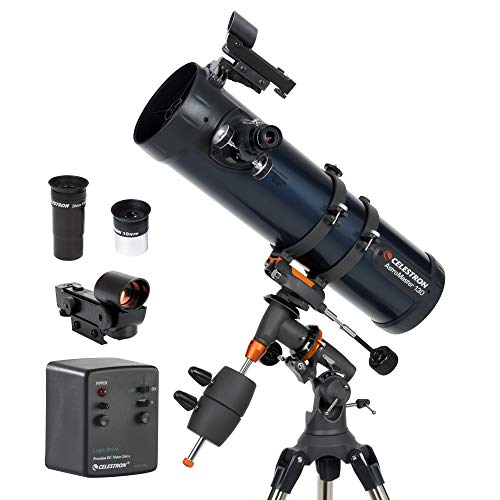
Celestron AstroMaster 130EQMD Newtonian Reflector
For high-precision tracking, view our comparison of manual equatorial telescopes.
$428.99 price checked August 2026
Telescope Optical Designs
Telescope optical designs describe how the telescope uses mirrors or lenses to bring light to your eye.
- Refractor – This design uses a glass lens at the front to bend light to a focus point at the back. Refractors are durable and offer high-contrast images, making them popular for planetary observation.
- Reflector (Newtonian) – This design uses a curved mirror at the back to reflect light forward to a side-mounted eyepiece. Reflectors offer a larger aperture for a lower price point than refractors of the same size.
- Schmidt-Cassegrain – This is a compound design using a combination of mirrors and lenses to fold the light path into a short tube. These telescopes provide long focal lengths in a very compact body, making them ideal for portability.
- Dobsonian – This is not a lens type but a mount style for Newtonian reflectors. It places the telescope on a simple wooden base that allows for rapid, easy movement in any direction.
- Chromatic Aberration – This is an optical flaw where light fails to focus at the same point, creating “purple fringing” around bright objects. A higher quality of glass or a specialized “Achromatic” or “ED” lens will reduce this effect.
Telescope Mounting and Tracking
Telescope mounting and tracking determine how the telescope moves and stays pointed at a specific object in the night sky.
You can learn about different designs by exploring the various types of telescopes available today.
- Alt-Azimuth (AZ) Mount – This mount moves up-and-down and left-to-right, similar to a standard camera tripod. These are simpler to use and cheaper but require manual adjustment to keep an object centered as the Earth rotates.
- Equatorial (EQ) Mount – This mount is tilted to align with the Earth’s axis of rotation. It allows you to track a star by moving the telescope in only one direction, which is essential for long-exposure photography.
- GoTo System – This is a computerized tracking system that allows the telescope to automatically find and center objects. A GoTo system requires an alignment process but significantly reduces the time spent searching the sky.
- Tracking Speed – This is the rate at which a motorized mount moves to counteract the Earth’s rotation. Accurate tracking is necessary for keeping planets steady in the eyepiece or for taking long-exposure photos.
- Weight Capacity – This is the maximum weight a mount can hold, including the telescope and any accessories. You must ensure the mount’s capacity exceeds the weight of your specific telescope to prevent “shake” or instability.
Telescope Terms Often Confused
Buyers often confuse several terms because they sound similar or are related to the same optical principles.
Aperture vs. Focal Length
Aperture is the size of the “bucket” catching the light, while focal length is the “magnifying power” of the lens. A telescope can have a large aperture but a short focal length (wide view) or a small aperture and a long focal length (narrow, high-power view).
Refractor vs. Reflector
A refractor uses a glass lens at the front, whereas a reflector uses a curved mirror at the back. Refractors are generally more expensive per inch of aperture but require less maintenance, while reflectors provide more aperture for your money but may require occasional mirror alignment.
Magnification vs. Resolution
Magnification makes an object look larger, but resolution is the ability to see fine detail. If you use too much magnification on a small aperture, you will see a large image that is blurry; you need a larger aperture to increase resolution.
Alt-Azimuth vs. Equatorial Mounts
An Alt-Azimuth mount moves in two axes (up/down, left/right) and is easier to set up. An Equatorial mount moves along the celestial pole and is much more complex to align but is the only way to track stars smoothly for photography.