Weight in a Schmidt-Cassegrain Telescope describes the physical mass of the optical tube assembly and its associated hardware. The correct weight for your needs depends on your intended transport method and the physical limits of your mounting infrastructure.
Which Schmidt-Cassegrain Telescope Weight Suits You?
| If this is you | The Weight that suits you | Why |
|---|---|---|
| You plan to transport the telescope in a standard passenger vehicle trunk. | Under 50 lb | Lower weights allow for easier manual loading and unloading without specialized equipment. |
| You require a portable setup for frequent trips to remote locations. | Under 30 lb | A lighter unit minimizes physical strain during hiking or repeated manual repositioning. |
| You intend to keep the telescope in a permanent, fixed location. | No specific limit | If the telescope never moves, the weight only matters relative to the stability of the permanent mount. |
| You have a heavy-duty, high-capacity equatorial mount. | Over 60 lb | Larger apertures require more mass for stability, which heavy-duty mounts are engineered to handle. |
| You are mounting the telescope on a balcony or small patio. | Under 40 lb | Lower weights reduce the structural load on residential railings or smaller deck supports. |
Schmidt-cassegrain Telescopes covered by our own reviews
3 reviewed options, $1199 to $2999, with the full write-up behind each name.
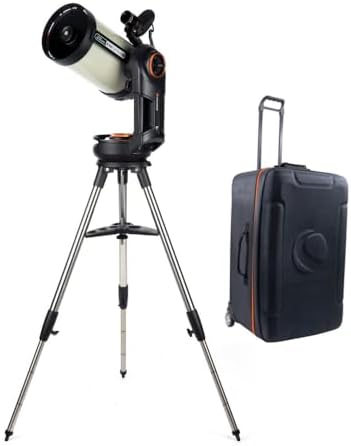

Celestron NexStar Evolution 8 WiFi
For those focusing on the moon and planets, explore the best schmidt-cassegrain telescope for planetary viewing.
$1699 price checked August 2026

Celestron NexStar Evolution 6 150mm f/10
$1199 price checked August 2026
Read our full NexStar Evolution 6 review
Understanding the speed of your optics is vital, so learn how to choose your focal ratio.
How Do I Measure or Verify the Weight of a Schmidt-Cassegrain Telescope?
To establish your own weight requirements, you must identify the total weight of the optical tube assembly (OTA) plus any required accessories. Most manufacturers list the weight of the telescope body in the technical specifications section of the documentation or on the product’s retail listing.
Checking Manufacturer Specifications
Look for the “Weight” or “Mass” entry in the technical data table. This value typically refers only to the telescope tube itself. If you plan to move the telescope frequently, you must add the weight of the finderscope, diagonal, and any heavy-duty carrying cases to this number.
Calculating Total Transport Weight
Determine the total weight by adding the OTA mass to the weight of your primary accessories. For example, a heavy-duty carrying case can add 10 lb to 15 lb to the total weight. If you are using a motorized slewing system, ensure the weight of the telescope does not exceed the maximum payload capacity of that specific motor system.
What Happens if the Weight is Too High or Too Low?
Choosing a weight that is too high for your situation results in mechanical instability or physical strain. If the telescope’s weight exceeds the balance point of your mount, it can cause the gears to bind or the tracking to become jerky during long-exposure photography.
Issues with Excessive Weight
An overweight Schmidt-Cassegrain Telescope can cause “mirror flop” if the mount is not sufficiently rigid. This occurs when the weight of the tube causes the primary mirror to shift slightly within its cell during tracking. Furthermore, heavy units may require a larger footprint for the tripod, which may not fit in your planned observation area.
You should also consider how to choose your focal length to ensure the telescope meets your specific observation needs.
Issues with Insufficient Weight
While a lower weight is often easier to manage, an extremely light telescope may lack the physical mass needed to dampen vibrations. In high-wind conditions, a very light Schmidt-Cassegrain Telescope might shake more easily than a heavier, more substantial unit, potentially blurring your images.
What Should I Do if I Fall Between Two Weight Categories?
If your requirements fall between two weight categories, you should prioritize the stability of your mounting system over the ease of transport. If you are unsure whether you can handle a heavier unit, evaluate the specific transport distance you will travel with the equipment.
Prioritizing Mount Stability
If you are choosing between a 45 lb and a 55 lb telescope, and your mount is rated for 75 lb, the 55 lb unit provides more physical mass to resist wind and vibration. The 10 lb difference is negligible for the mount but provides a more stable platform for the optics.
Prioritizing Portability
If your mount is limited to a 50 lb capacity, you must choose the lighter option. A telescope that exceeds the mount’s weight limit will cause the motors to overheat and the tracking to fail. In this case, the ease of transport is secondary to the mechanical limits of your hardware.
Reviewing Return Policies for Weight Discrepancies
Because weight is a physical constraint that can only be fully realized during transport or setup, check the return policy before ordering. If the weight exceeds your ability to move the unit, you need to know the specific conditions for returning a large, heavy item to the seller.
More Schmidt-cassegrain explainers and comparisons
- Best Schmidt-Cassegrain Telescope for Beginners
- Schmidt-Cassegrain Telescopes with Smartphone Control Compared
- Choosing the Best Schmidt-Cassegrain Telescope for Easy Setup
- The Schmidt-Cassegrain Telescopes That Work Best for Deep Space
- Which Schmidt-Cassegrain Telescope Is Best for Small Spaces?
- Best Schmidt-Cassegrain Telescope with Wifi